





 A new social browser set foot on the web. It operates a lot like Flock, and has plenty of promise to do the social browsing thing right. Rocketmelt has reached the world of internet as the new social browser in town. The people behind this project were also the ones who propelled Chrome, Google’s flagship browser. Moreover, this Rocketmelt was built utilizing the same Chromium framework that made up Chrome, a system many developers are interested in, even beyond Firefox.
Per RockMelt’s announcement on its blog:
“RockMelt does more than just navigate Web pages. It makes it easy for you to do the things you do every single day on the Web: share and keep up with your friends, stay up-to-date on news and information, and search. And of course, RockMelt is fast, secure, and stable because it’s built on Chromium, the open source project behind Google’s Chrome browser. It’s your browser – re-imagined and built for how you use the Web.”
Concentrated heavily on social networking sites such as Facebook and Twitter, Rocketmelt will allow users to chat, send messages, share pictures, share videos update current status and check out status updates by friends in the previously mentioned social networking sites, regardless of what site you are currently browsing. Similarly, you will have entrée to Twitter and RSS feeds— both are updated in the backdrop and use “push notifications” to inform you of the new message that has just arrived and new tweets posted by your friends.
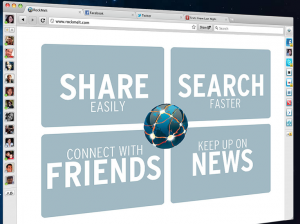 RockMelt is also the first browser to be completely backed by the cloud. This affiliation tells you that you can access your personal browsing experience from anywhere. And another benefit is that you get fast updates from the people and sites that are significant to you.
Rocketmelt also makes browsing so much faster. You do not have to navigate away from the page you are currently on; just a few clicks within the page and you are already in the site that you initially wanted.
As far as social browsers go, RocketMelt certainly has potential, as long as it executes the updates necessary to stay atop of these trends. Browsing will become more social, though no one has really found an optimal way to make it so, for a larger portion of consumer activity. One of RockMelt’s main draws is its personalization factor, which looks to make the most of individual experiences around the web. On a larger scale, this is part of the movement towards organizing data based on a series of factors, which includes browsing for RockMelt. As far as Chrome is concerned, its tie-in with Google’s other products makes it, and browsers and tools built on its framework, able to really tap into this personalization methodology.
Click here to see the video of RockMelt in action.
… We’d like to tell you about our mission and how you can help us fulfill it. SiliconANGLE Media Inc.’s business model is based on the intrinsic value of the content, not advertising. Unlike many online publications, we don’t have a paywall or run banner advertising, because we want to keep our journalism open, without influence or the need to chase traffic.The journalism, reporting and commentary on SiliconANGLE — along with live, unscripted video from our Silicon Valley studio and globe-trotting video teams at theCUBE — take a lot of hard work, time and money. Keeping the quality high requires the support of sponsors who are aligned with our vision of ad-free journalism content.
If you like the reporting, video interviews and other ad-free content here, please take a moment to check out a sample of the video content supported by our sponsors, tweet your support, and keep coming back to SiliconANGLE.






