







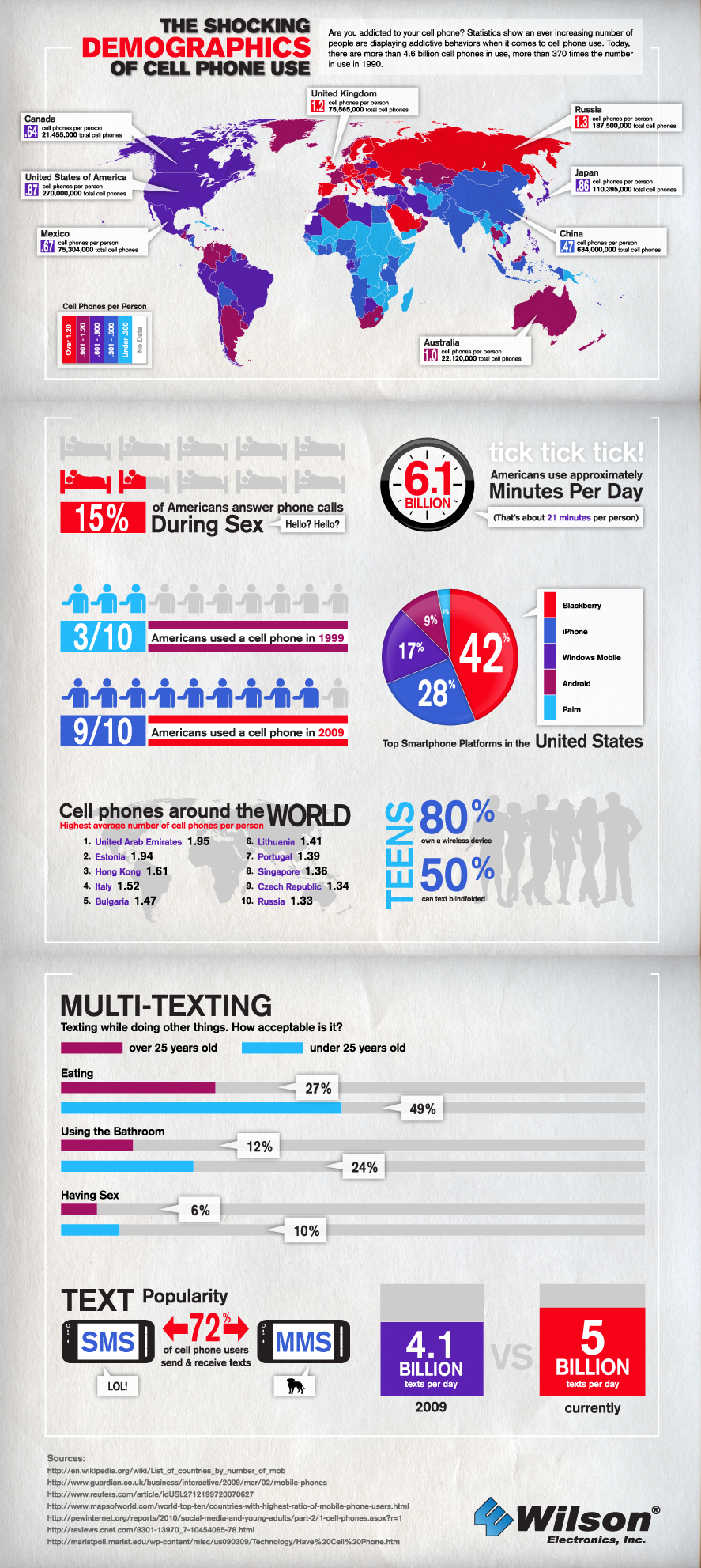
 According to a survey on the worldwide use of cell phones, it seems that there are over 4.6 billion cell phones in use, a 379 times bigger number than in 1990. Countries such as the United Kingdom, Russia, Spain, the United Arab Emirates, Italy, Germany and North European countries have an average of 1.2 cell phones per person.
Australia, Algeria, Argentina, Kazakhstan and Greenland follow them by indicating an average number of 1 cell phone per person. Canada, the United States of America, Mexico, Libya and Mauritania position themselves among the states with 0.67-0.87 cell phones per person.
Egypt and Bolivia for instance have around 0.3-0.6 cell phones per person , whereas Central Africa states along with Thailand, Afghanistan, Pakistan and Bolivia have an average number of under 0.3 cell phones per person.
A very intriguing stat for America cell phone behavior is highlighted in this infographic, showing the average conversation per person is around 21 minutes, and 15 percent of Americans admit to answering phone calls during sex (are phone calls that important, or is sex that boring?).
Of this latest trend we have the smartphone in the US, of which the most popular is the Blackberry, covering 42 percent of the preferences, followed then by the iPhone and Windows Mobile. Millennial Media’s latest S.M.A.R.T. Report shows similar trends in terms of OS and device preferences, though Android appears to be more dominant in the marketing sector in particular.
The youth segment seems to be the most exposed to new technologies since 80 percent of the world’s teens own a wireless device and over 50 percent of them can type blindfolded. Here we note how this emerging demographic is affecting the market, incurring new advertising opportunities among other developments.
Support our mission to keep content open and free by engaging with theCUBE community. Join theCUBE’s Alumni Trust Network, where technology leaders connect, share intelligence and create opportunities.
Founded by tech visionaries John Furrier and Dave Vellante, SiliconANGLE Media has built a dynamic ecosystem of industry-leading digital media brands that reach 15+ million elite tech professionals. Our new proprietary theCUBE AI Video Cloud is breaking ground in audience interaction, leveraging theCUBEai.com neural network to help technology companies make data-driven decisions and stay at the forefront of industry conversations.




