




 Many wonder where the mobile industry is headed—it’s poised for so many directions in software distribution (can we say app-happy?), mobile web access (hello HTML5), and much, much more. So what happens when you combine location, the web and a “pocket PC” into one device? A massive opportunity for growth from industry players like Appcelerator.
The company behind the Titanium mobile developer platform has grown its network to thousands of apps, all being created for an audience of increasing access, knowledge and demands. We get some insight to this burgeoning industry, thanks to Appelerator’s quarterly report, done in partnership with IDC, taking more into account than you could ever imagine.
The key findings from Appcelerator’s Q1 2011 Mobile Developer Report circle around tablet anticipation and developing mobile app strategies. The tablet perspective is of great interest, thanks to the iPad’s booming popularity and emerging devices from competitors, including Android OS manufacturers, RIM’s PlayBook, and even HP’s webOS.
Tablet interest is spiking across the board, with interest in the Android Tablet jumping 12 points in three months, taking 74% of the developers surveyed in this study. Expectations around Android’s tablet market are running high, with 57% of developers saying the price of resulting tablets will be the most important factor for success (so is that good or bad news for the Motorola XOOM, rumored to be priced rather competitively against the iPad?).
Interest in the PlayBook also rose significantly, nearly doubling its developer interest to 28%. Perhaps there’s something to be said about RIM’s slow and steady increase in market share, as tablets are being considered as a potentially great tool for enterprise employees.
 Some numbers I found particularly interesting were around connected TV, which is on the decline. Not even the growing tablet market has been able to incur big gains for online television content, with a decrease in developer interest around apps in this sector. This is partially attributed to Google’s dialed down efforts around its TV initiatives, along with red tape from TV networks, which has only gotten stickier now that tablets have arrived on the scene.
One app marketplace that may help regain support for mainstream media’s presence on tablets is the upcoming Amazon Appstore, which shows early promise, having taken 37% market share for developers interested in distributing apps through this portal. Surprisingly, this is on par with developer interest in the Mac App Store, encouraging the broadening marketplaces for apps. Android still owns a whopping 82% of this market, though budding interest in Verizon’s and GetJar’s app stores indicate serious expansion of app marketplaces in the coming year.
 All of these emerging devices, platforms and marketplaces have raised some interesting questions for developers, as to where they can go from here. Recalling a comment from Appcelerator VP Scott Schwarzhoff, the app environment and its methods around software distribution are no longer limited to single devices like the iPhone. Moving to a widespread strategy for pushing out mobile apps, many developers wonder what comes next, after the iPhone and iPad?
This really brings a focus on mobile app strategies, which is triggering a race among businesses to outline a sustainable approach to the market. Appcelerator and IDC are introducing a new “Mobile Maturity Model” to help businesses identify three phases of mobility adoption that are shaping up in the enterprise and consumer markets.
This development really requires some retrospection on what’s taken place in the past year or so, recognizing the changes that have taken place on th mobile scene. Appcelerator found that over half of its developers are shifting from a strategy focused on iPhone app releases to a more aggressive “acceleration” phase.
Making up this acceleration phase are a few key strategies, which include a multi-platform approach. On average, survey respondents said they plan to deploy apps on at last four different devices this year, which is a two-fold increase from 2010.
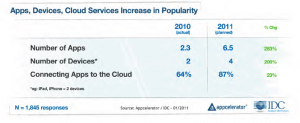 One really important note for these emerging strategies is the presence of the cloud. Eighty-seven percent of developers said their apps will connect to the cloud this year, increasing nearly 70% from last year’s developer response. Ubiquitous cloud-connectivity is becoming more central to mobile apps’ ability to add value to end users, and this is reflected in business models emerging in the mobile sector.
This is something I discussed with Schwarzhoff last week, as he hinted at Appcelerator’s big opportunities to position itself at the intersection of location-based features and cloud-based access. Making apps more “aware” is something that’s directly transferred to the user experience, building their interest, support and need for mobile apps.
Moving away from brand affinity apps to those that are more engaging has also modified the pricing structure around apps, as Appcelerator learns that developers are moving away from free, branded apps, and overall becoming less reliant on those 99-cent app sales. In-app purchases and advertising are setting consumers up for mobile commerce, where we’re sure to see lots of innovation from mobile app developers, and the platforms like Appcelerator that power their development.
… We’d like to tell you about our mission and how you can help us fulfill it. SiliconANGLE Media Inc.’s business model is based on the intrinsic value of the content, not advertising. Unlike many online publications, we don’t have a paywall or run banner advertising, because we want to keep our journalism open, without influence or the need to chase traffic.The journalism, reporting and commentary on SiliconANGLE — along with live, unscripted video from our Silicon Valley studio and globe-trotting video teams at theCUBE — take a lot of hard work, time and money. Keeping the quality high requires the support of sponsors who are aligned with our vision of ad-free journalism content.
If you like the reporting, video interviews and other ad-free content here, please take a moment to check out a sample of the video content supported by our sponsors, tweet your support, and keep coming back to SiliconANGLE.






