





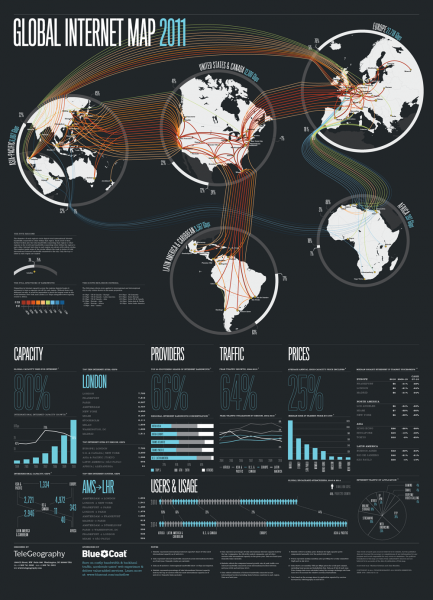
 What is the worldwide web? We know it spans the globe, and we know what we can do with it. But from a network perspective, what does it look like on a global scale? Communications research firm TeleGeography released its Global Internet Map for 2011, which provides some insight to the internet activity this year standing, as well as in the foreseeable future.
According to the report, global internet capacity has grown by 28 percent between 2004 and 2007, when it reached almost 30TB per second, but has declined by 15 percent until it reached only about 22TBs in 2010. In terms of capacity Europe is currently on the lead with Londonbeing the busiest city. North America and Los Angeles follow, as well as Asia and Latin America in that order.
Nevertheless, this ranking is expected to change entirely by 2014, when the Asia & Pacific region is forecasted to take the lead (as the fastest growing mobile market, which further contributes to greater internet usage.)
As the use of internet-connected mobile devices expands, notably in Asia, internet usage will steadily increase. This increase in demand will further strengthen the online economy, but the upcoming IPv4-IPv6 shift may just contribute to a very bumpy road website owners and online solutions providers will have to face. Naturally, this transit will also decrease the value IPv4 domain, but for now that isn’t the case – which is why Microsoft just both $7 million worth; exactly 666,624 addresses.
According to TeleGeography, London, Frankfurt and Paris are the top 3 cities with the most internet traffic in the world, followed by Amsterdam, New York, Miami and so on. This growth in internet usage both indoors and on the go via WiFi, and hotspot service provider JiWire gives an ever better insight to what’s behind the stats. This includes the fact that 54% of all those connecting on the go log on from hotels and resorts, 26% of users log on from cafes and 14.2% from airports.
… We’d like to tell you about our mission and how you can help us fulfill it. SiliconANGLE Media Inc.’s business model is based on the intrinsic value of the content, not advertising. Unlike many online publications, we don’t have a paywall or run banner advertising, because we want to keep our journalism open, without influence or the need to chase traffic.The journalism, reporting and commentary on SiliconANGLE — along with live, unscripted video from our Silicon Valley studio and globe-trotting video teams at theCUBE — take a lot of hard work, time and money. Keeping the quality high requires the support of sponsors who are aligned with our vision of ad-free journalism content.
If you like the reporting, video interviews and other ad-free content here, please take a moment to check out a sample of the video content supported by our sponsors, tweet your support, and keep coming back to SiliconANGLE.






