







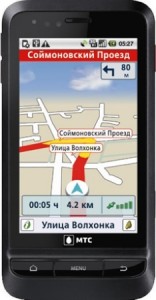
 Russia’s OAO Mobile Telesystem announced the launch of the first smartphone to have Russia’s Glonass satellite navigation system. Dubbed as MTS Glonass 945, it runs on Android 2.2, Froyo and is prices at RUB 10,490 (or 371 USD). The device will receive signals from both U.S. GPS system and Glonass in order to help user navigate despite location difficulties where signals could be interrupted. It doesn’t only work with MTS but with other networks as well.
This is undoubtedly one of the steps taken by Russia’s Prime Minister Vladimir Putin towards a modernized economy. The leader envisioned all of Russia’s cars to be embedded with Glonass by 2012. However, unlike GPS, Glonass doesn’t have an ample amount of satellites just yet. When the Russian Space Program tried to launch a rocket containing Glonass satellites last year, instead of garnering glory and a clearer gaze into a modern future, Putin and the Russian space program got embarrassment as the rocket crashed in the Pacific Ocean, near Hawaii.
But Android as a platform still proves a powerful and hopeful tool for navigation companies, even as they seek new formats for reaching consumers, and monzetizing data. A couple other navigation companies, such as Tomtom, are turning to the mobile sector as well. Their latest product, the Via Series, is going to be deployed to the United States and Canada. Navteq, a Nokia-owned navigation company also launched Destinations Maps, which offers not only outdoor maps but indoor maps as well such as maps of shopping centers. The platform alternative also provides access to consumers without having to create a new smartphone device. Google Maps 5.2.1, for example, still gives the users the ability to navigate the world.
Support our mission to keep content open and free by engaging with theCUBE community. Join theCUBE’s Alumni Trust Network, where technology leaders connect, share intelligence and create opportunities.
Founded by tech visionaries John Furrier and Dave Vellante, SiliconANGLE Media has built a dynamic ecosystem of industry-leading digital media brands that reach 15+ million elite tech professionals. Our new proprietary theCUBE AI Video Cloud is breaking ground in audience interaction, leveraging theCUBEai.com neural network to help technology companies make data-driven decisions and stay at the forefront of industry conversations.




