





 Not too long ago, a Pew Internet Project survey revealed that one third of American adults (35 percent) owns a smartphone. Now, Plaxo, creator of a universal address book, digs a little deeper into our smartphone behavior in its recently released Mobile & Online Backup Trends Study, centering on how smartphone users in the US utilize online backup tools and interact with their contacts. It covered demographics Gen Y, Gen X, Baby Boomers and the Greatest Generation.
“Living a mobile-ready lifestyle in both one’s professional and personal lives requires having information at your fingertips,” said Preston Smalley, general manager for Plaxo.
“These survey results reinforce the trend around an increasingly untethered world. Even though people are on the go more and more, they have not lowered their expectations around access to their latest updated data including their address book, and in fact, have increased expectations. Plaxo recognizes these market trends and offers innovative mobile services so people can find and reach those who are important to them. We take things a step further by actually automatically updating address book content with our new line of services.”
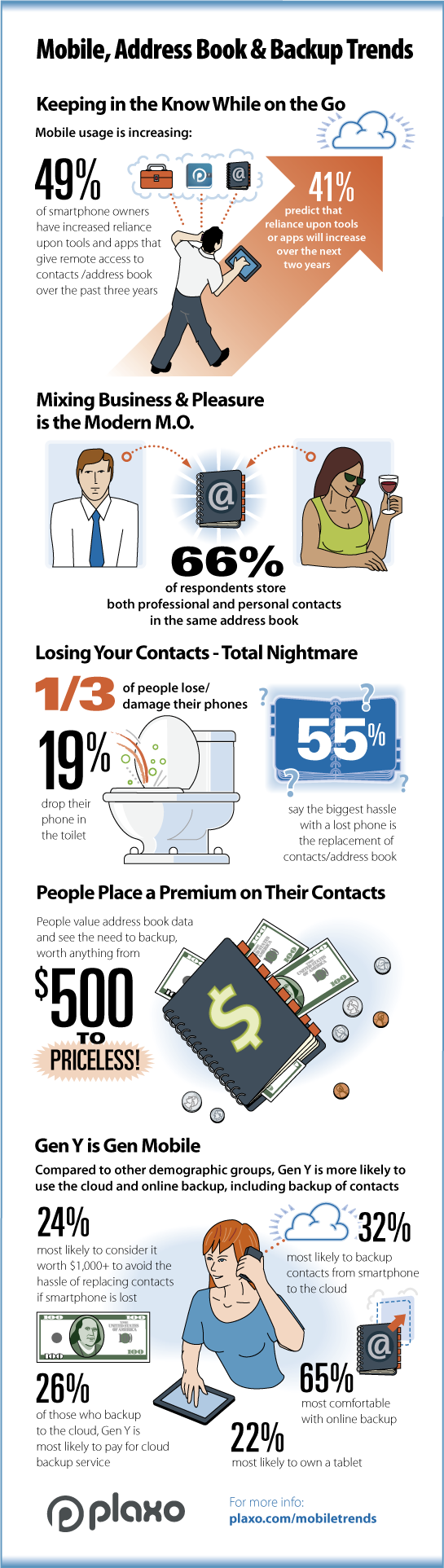
Users keep their contact information in more places than one –including PCs, laptops, smartphones, emails and social networks– with 71 percent of these contacts stored in their smartphones. Just about half of the respondents said they rely on remote access for their contacts and address more in the last three years than they did in the previous years, and two-fifths of them said they are likely to rely further on remote access over the next two years. The survey also reveals that 66 percent of mobile users do not segregate their professional and personal address book.
 And I agree with the 55 percent who said that the most hassling aftermath of losing a phone is losing one’s contacts along with it – above photos, documents/emails, apps, calendar and music. Moreover, the survey says that one in five has lost smartphone data by dropping it in the toilet (first-class clumsiness). 68 percent of the sample population tends to back up their personal computers more than any other device, which brings us to why only 1 in 10 considers avoiding the hassle of losing their address book ‘priceless.’ Those who back up their data to the cloud are likely to back up their contact/address book info on their smartphones as well, compared to those who don’t back up their computer data at all.
Gen Y (21-31 years old) tends to rely on tools and apps that support remote access to contacts, and are seeing an augmented confidence in it over the next two years.
Plaxo currently offers native apps on iPhone, BlackBerry, and Windows Mobile, and will have one for Android as well by the end of Q3. Plaxo greatly complements social networks and media companies by helping users assimilate their contacts across different internet assembly points (Facebook, LinkedIn, Outlook etc.) into one secure online address book.
In other data backup news, Mozy, another online backup leader, has recently launched a free mobile app to provide commercial users safe, secure and protected access to file from Android and iOS devices. The pro version of the app offers the benefit of other Mobile Mozy applications as well. We also have Dropbox changing their Terms of Service because of growing security concerns. It’s amazing how the cloud changed the way users –commercial and individuals alike—backup their data. Cloud storage was one of those preposterous ideas that paved the way to the metamorphosis of the internet.
… We’d like to tell you about our mission and how you can help us fulfill it. SiliconANGLE Media Inc.’s business model is based on the intrinsic value of the content, not advertising. Unlike many online publications, we don’t have a paywall or run banner advertising, because we want to keep our journalism open, without influence or the need to chase traffic.The journalism, reporting and commentary on SiliconANGLE — along with live, unscripted video from our Silicon Valley studio and globe-trotting video teams at theCUBE — take a lot of hard work, time and money. Keeping the quality high requires the support of sponsors who are aligned with our vision of ad-free journalism content.
If you like the reporting, video interviews and other ad-free content here, please take a moment to check out a sample of the video content supported by our sponsors, tweet your support, and keep coming back to SiliconANGLE.






