



 NEWS
NEWS
NEWS
NEWS
NEWS

 The London riots that have been going on recently are taking a serious toll from residents, including shop owners who have suffered substantial damages and even deprived of their livelihoods. One example is the 89-year-old Aaron Biber, whose barber shop that he has been running for over 40 years was hit by a wave of protestors.
Throughout the past few days, we reported how law enforcement agencies in England suspect rioters are using social media to communicate and coordinate their actions. Home secretary Theresa Maywill will be holding meetings with representatives from Facebook and Twitter in the coming weeks–networks that may eventually be temporarily blocked in the nation. In the case of Biber, however, three students showed that social media can also be used for good during these troubling times.
Bjorn Conradi, Sophie Browness and Omid Sard, who work at a London ad agency, started an internet campaign that helped raise £25,000 for the rebuilding of Biber’s shop.
“The big issue we also wanted to highlight was there was a lot of talk about social media enabling these riots. We wanted to show that young people and social media can also do a lot of good things,” Conradi told WSJ in an interview.
In addition to Facebook and Twitter, mobile is also involved. RIM recently gave local authorities access to its messaging platform, BBM, despite of a recent threat from hackers. The company’s blog has been breached, and a message was left behind saying that the attackers have obtained access to and will release employee data should the phonemaker not reverse its decision to cooperate with investigators.
Mobile is used by protestors for malicious purposes, but just like in the case social media, there are some who use it for other purposes. Citizen journalism has grown immensely in light of the riots, and the vigilante London Riot Facial Recognition group is using smartphones to identify protestors.
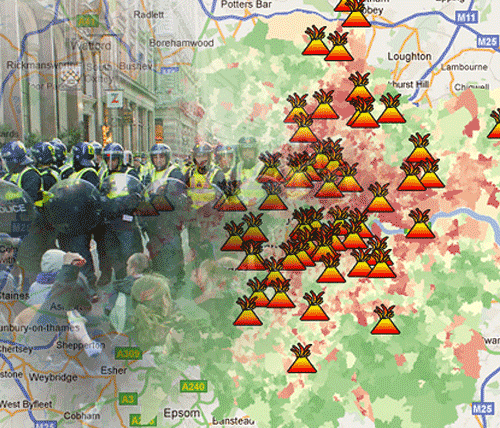
Another interesting highlight comes from NPR correspondent Matt Stiles, who used public data to create a map outlining the location of recent protests.
… We’d like to tell you about our mission and how you can help us fulfill it. SiliconANGLE Media Inc.’s business model is based on the intrinsic value of the content, not advertising. Unlike many online publications, we don’t have a paywall or run banner advertising, because we want to keep our journalism open, without influence or the need to chase traffic.The journalism, reporting and commentary on SiliconANGLE — along with live, unscripted video from our Silicon Valley studio and globe-trotting video teams at theCUBE — take a lot of hard work, time and money. Keeping the quality high requires the support of sponsors who are aligned with our vision of ad-free journalism content.
If you like the reporting, video interviews and other ad-free content here, please take a moment to check out a sample of the video content supported by our sponsors, tweet your support, and keep coming back to SiliconANGLE.






