



 NEWS
NEWS
NEWS
NEWS
NEWS

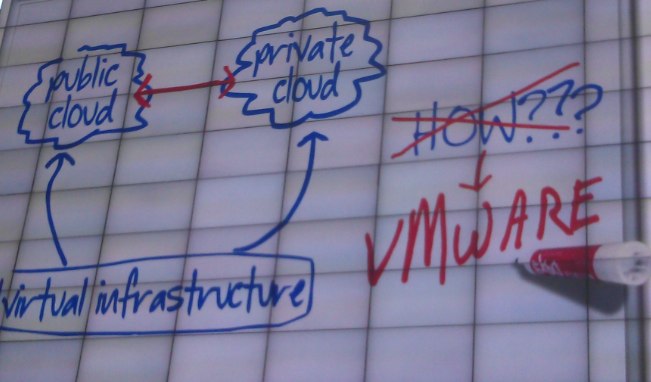
 The hybrid cloud is a major theme at VMworld this year and with it we are seeing the emergence of the platform as a key battle ground for VMware as it seeks to provide both infrastructure and platform capabilities.
We see this in a variety of ways:
VMware is striving to create to create a private, global cloud environment but with the flexibility that comes with a public service.
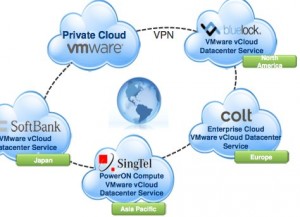 This is evident in vCloud Datacenter Global Connect, a global network of service providers that VMware is unveiling today.
 The global services infrastructure fits with VMware’s new vCloud Connector 1.5, which serves as a way to manage workloads between private and public clouds. In concert with this is a new global Web community intended for customers to find the right service providers for the workloads they seek to move to the cloud.
VMware’s vFabric Data Director is the company’s new database-as-a-service.
It is an example of universal themes in the market:
This DBaaS offering shows the increasing focus on developer centric services within an enterprise environment. It fits with CloudFoundry, the new VMware developer platform. Developers need an environment for developing apps and a database infrastructure as well.
This helps solve a problem now surfacing as app development increases. It comes in the form of “Shadow IT,” a term to describe how developers and lines of business are bypassing IT.
The result: thousands of databases are going unused, making it difficult at best to enforce security policy. These databases are not maintained uniformly, leading to availability problems.
VMware’s answer is a service that it maintains will provide enterprise grade security, standardized database templates and a single pane view to universally manage hundreds of databases.
It will initially be available in vFabric Postgres with additional support planned for other databases. It is available today on Cloud Foundry.
It’s significant how close we are getting to a world with two distinct approaches. There’s a VMware centric camp that is banking on forming alliances with service providers that control the world’s largest data centers. And then there’s open service providers such as OpenStack, which includes Citrix, one of VMware’s arch rivals.
VMware has a loyal following in IT. These are the people who come to VMworld every year to learn how they may continue to virtualize the enterprise. In this respect, VMware has a substantial opportunity. A hybrid service provides these loyal users with a way to extend the data center well beyond is physical walls.
But the battle ground is really in the platform world. VMware’s vFabric Data Director is a service meant for developers and the DevOps movmeent, and it pairs well with CloudFoundry. It’s here where I expect the most significant innovation as VMware competes with companies such as Red Hat and Salesforce.com for the hearts and minds of the developer community.
… We’d like to tell you about our mission and how you can help us fulfill it. SiliconANGLE Media Inc.’s business model is based on the intrinsic value of the content, not advertising. Unlike many online publications, we don’t have a paywall or run banner advertising, because we want to keep our journalism open, without influence or the need to chase traffic.The journalism, reporting and commentary on SiliconANGLE — along with live, unscripted video from our Silicon Valley studio and globe-trotting video teams at theCUBE — take a lot of hard work, time and money. Keeping the quality high requires the support of sponsors who are aligned with our vision of ad-free journalism content.
If you like the reporting, video interviews and other ad-free content here, please take a moment to check out a sample of the video content supported by our sponsors, tweet your support, and keep coming back to SiliconANGLE.






