




It has been a historic week with the passing of Apple CEO Steve Jobs who was an unrivaled genius of our time. Mr. Jobs and his team of engineers, designers, and company radically transformed the manner in which information is accessed by the human race. The iPhone revolutionized the computing and wireless communications industry and launched a fierce race for smartphone supremacy.
Four years ago, RIM and Microsoft ruled the smartphone world. Two years ago, the iPhone rocketed to the number two spot with an almost nonexistent Google Android market. Today, Google Android devices rule the world and outsell Apple iPhone by a margin of 2-to-1, bucking the notion that Apple’s dominant App Store and seamless product integration is an unbeatable differentiator. More smartphone buyers seem to prefer a more open platform like Android, wider range of devices, and the ability to add MicroSD flash storage cards.
Some buyers may prefer the larger widescreens available on Android devices. The larger housing also allows Android devices to support the additional chips needed for the faster LTE carrier wireless networks while Apple has to wait for LTE chips to shrink. The combination of faster network access, larger display, wider hardware selection, and open platform might explain the success that Google Android is having over Apple iOS. Apple, on the other hand, chooses incremental upgrades on an annual basis and strictly adheres to a one-size-fits-all approach.
Some like Dustin Curtis are defending Apple’s approach saying that the 3.5″ form factor is the only one that makes sense, since larger phones are harder to operate with one hand, and the thumb supposedly can’t reach every part of the larger display. But Curtis drew a non-scale diagram that falsely skews the benefits of a smaller phone by illustrating a smaller thumb on the larger phone. I also checked this physically on a larger smartphone and my average size thumb can reach every part of the display and beyond.
In reality, larger Android phones like the upcoming Samsung Nexus Prime are only 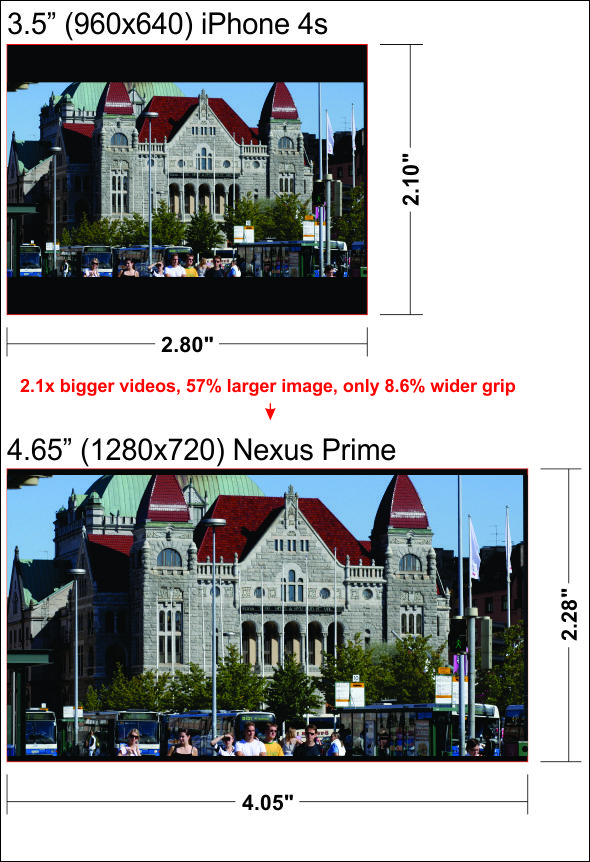 around 8.6% wider as seen in the illustration below. However, the Prime’s widescreen display has 57% more viewing area and widescreen movies or videos will appear more than double the size of an iPhone movie.
When looking at the two displays drawn to scale side-by-side, the difference in viewing experience is astounding, with only a minimal increase in the width of the Nexus Prime, so it won’t be noticeably more difficult to grip. This is a massive 2.1-fold improvement for movies and television programming and for virtually all the videos recorded smartphones including the iPhone.
The movie and video industry has standardized on the widescreen format while Apple has stuck to the more squarish display format relevant 15 years ago. Most software applications are more agnostic about aspect ratio since they can accommodate different resolutions and display shapes and web pages can benefit from reduced scrolling. Video, on the other hand, cannot change aspect ratios without destructive cropping. While Apple’s overall design genius is undeniable, the display size and form factor of their iPhone will keep them from meeting the needs of consumers who care about video playback and network performance.
[Cross-posted at High Tech Forum]
… We’d like to tell you about our mission and how you can help us fulfill it. SiliconANGLE Media Inc.’s business model is based on the intrinsic value of the content, not advertising. Unlike many online publications, we don’t have a paywall or run banner advertising, because we want to keep our journalism open, without influence or the need to chase traffic.The journalism, reporting and commentary on SiliconANGLE — along with live, unscripted video from our Silicon Valley studio and globe-trotting video teams at theCUBE — take a lot of hard work, time and money. Keeping the quality high requires the support of sponsors who are aligned with our vision of ad-free journalism content.
If you like the reporting, video interviews and other ad-free content here, please take a moment to check out a sample of the video content supported by our sponsors, tweet your support, and keep coming back to SiliconANGLE.






