




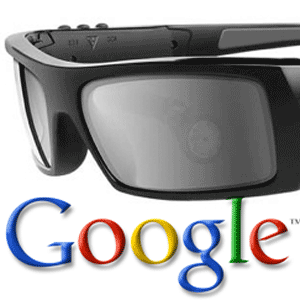
 It looks like all those rumors about Google working on cyber-glasses are beginning to take shape and, according to reports, we might even see them on the market before the end of 2012. No more constantly flicking on a smartphone to check on the state of the world, instead we’ll be able to stream that information directly to glasses as a Heads Up Display (or HUD.) 9TO5Google initially discovered these rumors and brought them to light last December, but now there’s even more information for everyone to chew on.
From the specs we do know currently on the project, the Google-glasses look extremely amazing. An article in the New York Times outlines what we may be able to expect in cost and manufacture,
According to several Google employees familiar with the project who asked not to be named, the glasses will go on sale to the public by the end of the year. These people said they are expected “to cost around the price of current smartphones,” or $250 to $600.
The people familiar with the Google glasses said they would be Android-based, and will include a small screen that will sit a few inches from someone’s eye. They will also have a 3G or 4G data connection and a number of sensors including motion and GPS.
Wearable computers for a long time have attempted to provide their information to the user via a screen near the eye (often in the form of a cybernetic-looking monocle or overly bulky glasses.) If Google can miniaturize enough to get a small computer, sensors, and a power source into glasses than we’ll have the first step towards mainstreaming this sort of technology.
Already we’ve seen augmented reality making its debut in smartphones by making the face of the mobile device into a “window” that displays what the camera can see but with an overlay of metadata. Do this with glasses that can overlay metadata and GPS information into the view of the user without them having to adjust their glasses every time and it will revolutionize the way that people interact with their surrounds in relation to the Internet.
From what we understand, the glasses will be built over Oakley Thumps (a rather bulky sunglass chassis), the HUD display will not be transparent and only work for one eye—so essentially it’s the gargoyle monocle, but hidden inside spectacles. The glasses themselves are thick enough to house the sensors, cellular antenna, and smartphone CPU, as well as a power source. Although little is known about all the internals that will go into it except for its obvious Google Android leanings and some specs from the 9TO5Google article,
I/O on the glasses will also include voice input and output, and we are told the CPU/RAM/storage hardware is near the equivalent of a generation-old Android smartphone. As a guess, we would speculate something like 1GHzARMA8, 256MBRAMand 8GB of storage? In any case, it will also function as a smartphone.
It’s also been stated the user-interface will use head tilting for scroll and click—the onboard system will adapt to the user in order to more quickly train itself to recognize users’ movement habits. Although, we at SiliconANGLE have seen technology demonstrated that can track the gaze and, of course, gesture-recognition would have amazing applications for Internet-enabled HUD glasses.
All of these are powerful components of immersive augmented reality and chances are good if Google does not innovate with these in their glasses, someone else will shortly after they come to market.
… We’d like to tell you about our mission and how you can help us fulfill it. SiliconANGLE Media Inc.’s business model is based on the intrinsic value of the content, not advertising. Unlike many online publications, we don’t have a paywall or run banner advertising, because we want to keep our journalism open, without influence or the need to chase traffic.The journalism, reporting and commentary on SiliconANGLE — along with live, unscripted video from our Silicon Valley studio and globe-trotting video teams at theCUBE — take a lot of hard work, time and money. Keeping the quality high requires the support of sponsors who are aligned with our vision of ad-free journalism content.
If you like the reporting, video interviews and other ad-free content here, please take a moment to check out a sample of the video content supported by our sponsors, tweet your support, and keep coming back to SiliconANGLE.






