





 Big data plays a major role in analyzing past and current data to calculate future probabilities. With this in mind, let’s take a look at the status of women’s health.
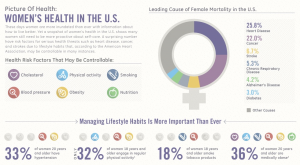
It’s disheartening how women in the US are still at high risk of disease despite the fact that raising awareness is easier than ever. These diseases are surprisingly serious, which includes heart disease, cancer and strokes. The American Heart Association said the health risk factors –obesity, cholesterol, blood pressure, and smoking— are triggered by lifestyle, and are therefore manageable and avoidable.
To give you an idea of how much lifestyle habits are overlooked, 33 percent of women 20 years and older have hypertension, while only 32 percent of women 18 years and above engage in regular physical activity. Moreover 18 percent of woman 18 years and older smoke tobacco products, and 36 of women 20 years and up are medically obese.
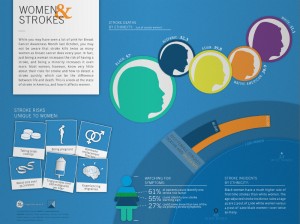 Heart disease tops the chart of the women killers, ticking off 25.8 percent of the demographic, followed by cancer and strokes at 22 percent and 6.7 percent respectively. Diabetes comes last with only 3 percent. In the US, strokes kill twice as many women than cancer every year, and being a minority increases the risk all the more. To aggravate the situation, most women even don’t know how to detect stroke quickly.
Black women are at risk of stroke the most, biting off 57 percent of the demographic, followed by Whites, Asians, Hispanics, and lastly Native Americans with 41.1 percent, 39.8 percent, 32.2 percent and 30.9 percent, in that order.
Here’s an interesting report from the Chicago Tribune detailing women on reproduction and fertility. The report highlights that 6,000 women in the US hit menopausal stage a day. Mississippi has the highest teen birth rate, but all in all, teenage pregnancies are down especially in the North and Northeast. Only 12 percent of women suffer from infertility, a third of which is because of the woman, a third because of her partner, and a third is a combo of other undetermined factors. The use of contraceptives is rampant among women with 62 percent using it. Pills is the no. 1 contraceptive used, followed by sterilization of women, then by sterilization of men.
This information would have been harder to point out if it were not for big data. With cancer awareness painting pink in the air, it would have been difficult for most to notice that stroke is a more serious problem that women are facing these days. Big data is making strides in healthcare, enabling us to learn more about our health faster than ever.
… We’d like to tell you about our mission and how you can help us fulfill it. SiliconANGLE Media Inc.’s business model is based on the intrinsic value of the content, not advertising. Unlike many online publications, we don’t have a paywall or run banner advertising, because we want to keep our journalism open, without influence or the need to chase traffic.The journalism, reporting and commentary on SiliconANGLE — along with live, unscripted video from our Silicon Valley studio and globe-trotting video teams at theCUBE — take a lot of hard work, time and money. Keeping the quality high requires the support of sponsors who are aligned with our vision of ad-free journalism content.
If you like the reporting, video interviews and other ad-free content here, please take a moment to check out a sample of the video content supported by our sponsors, tweet your support, and keep coming back to SiliconANGLE.






