





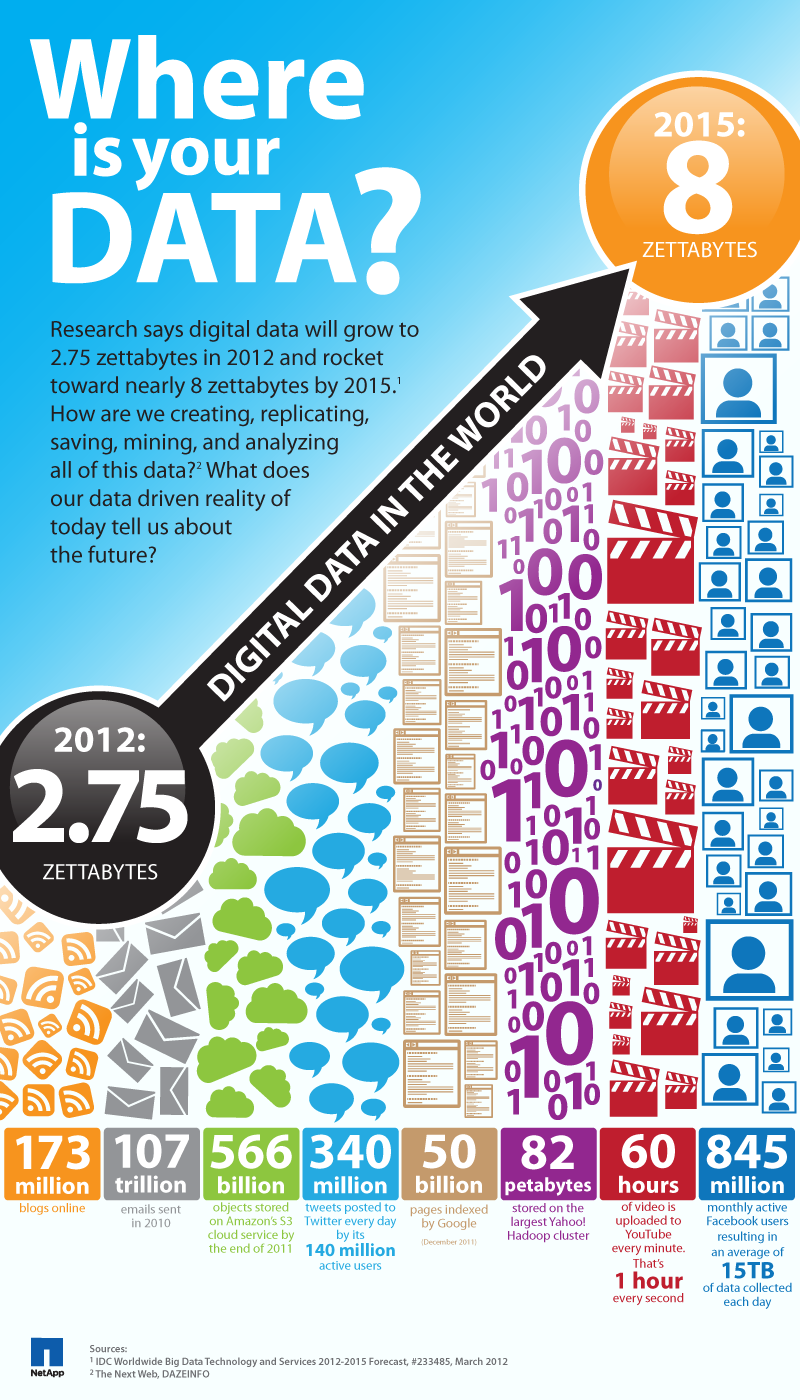
 NetApp is a company whose entire business is dependent on the way enterprises store their data, and this industry is not expected to face a decline anytime soon. That’s according to a newly released infographic by the company (see below), which visualizes a couple of predictions quantifying all the data on the worldwide web.
In 2009, the internet weighed in at about 500 exabytes, or half a zettabyte. At the end of fiscal 2011, disk kingpin Seagate said it sold more than half that amount – 330 exabytes – within only 12 months, and by the end of this year a total of 2.5 zettabytes will be stored globally.
That’s the figure NetApp cites in its infographic, alongside some extra figures to validate that it’s all matter of accuracy rather than a question of when and if. Today Facebook collects 15 terabytes of data a day from its 850 million users, and 340 million tweets cross the wire in the same period. At the same time some 60 hours of video are being uploaded to YouTube every minute, and as of 2012 Google has indexed 50 billion pages and counting.
This exponential growth is widely expected to sustain in the long run. In 2015 this year’s record will be upped to 8 zettabytes of data.
NetApp’s latest report is not the only recent sign suggesting that the vendor has in fact caught the market’s drift. Late last month the company rolled out an update to its SANtricity software adding new data management features, and a few days ago DataDirect made a push in the same direction.
DDN announced that it is participating in the Open Compute Project, an initiative started by Facebook to encourage next generation data center environments that – among other things – are specifically architecture to handle massive datasets.
… We’d like to tell you about our mission and how you can help us fulfill it. SiliconANGLE Media Inc.’s business model is based on the intrinsic value of the content, not advertising. Unlike many online publications, we don’t have a paywall or run banner advertising, because we want to keep our journalism open, without influence or the need to chase traffic.The journalism, reporting and commentary on SiliconANGLE — along with live, unscripted video from our Silicon Valley studio and globe-trotting video teams at theCUBE — take a lot of hard work, time and money. Keeping the quality high requires the support of sponsors who are aligned with our vision of ad-free journalism content.
If you like the reporting, video interviews and other ad-free content here, please take a moment to check out a sample of the video content supported by our sponsors, tweet your support, and keep coming back to SiliconANGLE.






