



 NEWS
NEWS
NEWS
NEWS
NEWS

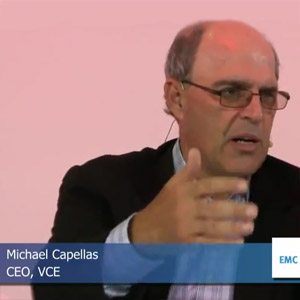
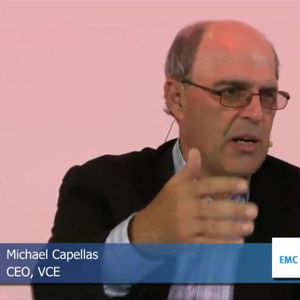 Dave Vellante and Stu Miniman of Wikibon brought Michael Capellas, chairman of technology company VCE, into theCube at EMC World 2012 and spoke about the market for infrastructure solutions. As an infrastructure provider using a channeled distribution model and partnering with the best-in-breed in the market such as EMC, Intel, and Cisco, Capellas sees that VCE may forge the next turnkey generation of infrastructure building in order to allow IT departments to drop-in infrastructure.
Vellante spoke with Capellas about why VCE is so important from a practitioner’s perspective. “I want to write one place, and I don’t really want to care about the physical layer beneath it,” Capellas said about infrastructure. “Between both Cisco and EMC, we knew there would be a convergence between where the network starts and compute ends.”
He continued, mentioning the expectations on new mainframes that could be created via bridging within the convergence between computation and communication.
IBM, he says, has a lot of understanding of the software stack for mainframes, and they added services in the cloud layer to that. In a way, IBM validates markets when it enters into them and “a high tide floats all ships.”
VCE wants to take the absolute best-in-class, such as Cisco with networking and fabric, and Intel blades for the compute and approach from both sides. It’s fitting this is being discussed at EMC World 2012 as EMC has seen a great deal of promise in VCE and sought to invest in VCE’s solution systems and coupled in VMware to virtualize the infrastructure.
Much of his discussion is about virtualization and whole-product solution and this maps back to previous interviews about companies who provide not just service but infrastructures. Between Cisco for network, Intel for computation (blades), and EMC for the rapid storage means that they have everything they need for a virtualizable infrastructure fabric.
We’ve seen a few use-cases of this enter the market and it feels a lot like hardware infrastructure to support a private cloud. Recently, the Tyler Independent School District, the largest in Northeast Texas, looked to VCE to help power their educational computer systems and provide a highly virtualized data center, giving students and faculty unfettered and rapid access to applications in their own secure private cloud.
Schools and other segments aren’t technology companies, they’re service sectors who work with people and they rely on their IT departments to do the heavy lifting and provisions. As a result, by choosing VCE the Tyler IDS of Texas allowed some of that weight to be taken off with the server support and left them to look to providing the proper software and applications for the educational environment onto that infrastructure.
Other sectors might also benefit from this sort of drop-in solution as well, believes Capellas and that’s what makes VCE the powerful startup it is right now.
[Edit May 23, 2012: Correction made to reflect Michael Capellas’s proper title within VCE.]
… We’d like to tell you about our mission and how you can help us fulfill it. SiliconANGLE Media Inc.’s business model is based on the intrinsic value of the content, not advertising. Unlike many online publications, we don’t have a paywall or run banner advertising, because we want to keep our journalism open, without influence or the need to chase traffic.The journalism, reporting and commentary on SiliconANGLE — along with live, unscripted video from our Silicon Valley studio and globe-trotting video teams at theCUBE — take a lot of hard work, time and money. Keeping the quality high requires the support of sponsors who are aligned with our vision of ad-free journalism content.
If you like the reporting, video interviews and other ad-free content here, please take a moment to check out a sample of the video content supported by our sponsors, tweet your support, and keep coming back to SiliconANGLE.






