



 NEWS
NEWS
NEWS
NEWS
NEWS

Wikibon Co-Founder and CTO David Floyer is definitely not on Larry Ellison’s Christmas card list this year. Not satisfied with his original exposition of the limited value of Oraclea week ago, Floyer has co-published a detailed, item-by-item examination of why it falls short with Wikibon Analyst Nick Allen.

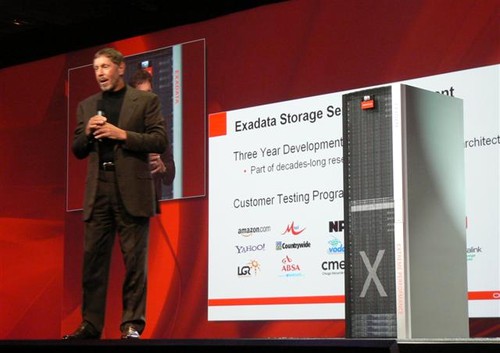
Why is this man smiling?
Titled “Comparing Oracle Exadata Storage with Best-of-Breed Arrays” the Wikibon Professional Alert is built around three tables. The first lists the advanced functionality available across the board on best-of-breed Tier 1 storage not available on Exadata. These include support for numerous RAID types, consistency groups, snapshot copies, writable snapshots, clones, mix-and-match HHD types, SSDs, fibre channel front-ends, FCOE front-ends, iSCSI front-ends, NFS and CIFS support, fibre channel back-ends, and several others, some of which are no longer cutting edge.
The second identifies 21 features available on both classes of arrays but notes that Exadata only provides limited support for nine of these, including capacity-on-demand, performance and capacity monitoring and reporting, and both DRAM and flash write cache.
The third table explains the two features that are exclusive to Exadata: Full table scan and Oracle hybrid columnar compression. The authors concede that these two features can save users some money in specific applications when running Oracle databases. However, they argue that even with those two unique features, Exadata falls far short overall as Tier 1 storage and is more expensive in almost all cases.
They conclude that despite the hype surrounding it, Exadata’s value proposition is very narrow. And while it does deliver value within that limited application breadth by simplifying IT infrastructure, “that convenience will come at a steep price in the form of ongoing lock-in to Oracle’s ‘Red Stack.’”
This article is a must-read for CIOs and storage buyers considering Exadata for their data centers, including those many enterprises running critical large databases on Oracle. Like all its research, this is available free of charge to interested parties on the Wikibon Web site.
… We’d like to tell you about our mission and how you can help us fulfill it. SiliconANGLE Media Inc.’s business model is based on the intrinsic value of the content, not advertising. Unlike many online publications, we don’t have a paywall or run banner advertising, because we want to keep our journalism open, without influence or the need to chase traffic.The journalism, reporting and commentary on SiliconANGLE — along with live, unscripted video from our Silicon Valley studio and globe-trotting video teams at theCUBE — take a lot of hard work, time and money. Keeping the quality high requires the support of sponsors who are aligned with our vision of ad-free journalism content.
If you like the reporting, video interviews and other ad-free content here, please take a moment to check out a sample of the video content supported by our sponsors, tweet your support, and keep coming back to SiliconANGLE.






