



 NEWS
NEWS
NEWS
NEWS
NEWS

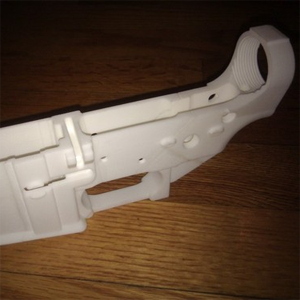
 Cody Wilson, a law student at the University of Texas at Austin, discovered his project to attempt to created a 3D printed gun with a leased uPrint SE 3D printer suddenly cut short when the company that leased the printer to him recalled their device. They’d heard that he intended to use the equipment to make the handgun and decided that this was too much of a liability for the company.
According to an article in the New Scientist, Stratasys—manufacturer of the 3D printer Wilson was using—sent him a letter stating that they’d prefer their machine not be used in the production of any guns:
“The company is less than thrilled with what we’re doing. They’re trying to prevent me from breaking any laws with their product,” Wilson told New Scientist. With several friends, he has founded a group called Defense Distributed to promote ideas about universal gun ownership.
In a letter to Wilson, lawyers for Stratasys cited his lack of a federal firearms manufacturer’s licence as their reason for the repossession, adding that it does not knowingly allow its printers to be used for illegal purposes. Wilson countered that his group’s aim is to disseminate a printable gun design online, not print guns per se.
The project is called Defense Distributed and the letter from Stratasys is posted on their Tumblr blog.
Insofar, no guns have actually been printed by Wilson. They only exist as digital plans on computers for a 3D printer capable of working with materials capable of surviving firing. We’ve seen several different products that act as 3D printers at the consumer level, but few of them work with materials that would not deform under the high temperatures that would be produced during the ignition of bullet propellant.
We certainly anticipate that even the amazing MakerBot would not be capable of making a suitable gun product at this time; although looking at how materials science is advancing, the in-home manufacture of many parts of a gun may not be far off as the era of the physible approaches. It should also be noted, that just because someone can download the plans for and print a gun using a 3D printer, it is not necessarily illegal across most of the United States even now.
More sophisticated printers capable of fusing metals and other high temperature materials are relegated to high end machine shops—especially those that might need highly customized parts or prototype parts for unique vehicles. These machines tend to cost in the range of $800,000.
However, we have seen the technology slowly becoming more real and more affordable with the progression of the MakerBot. It’s obvious that eventually we will start to see units that could cut and fuse metal parts that might be affordable enough to sit in someone’s garage. The capability to print a firearm is only one of the many different questions that might be asked by regulatory organizations and it’s one not too unexpected even amidst sudden questions of copyright and control of physical products.
… We’d like to tell you about our mission and how you can help us fulfill it. SiliconANGLE Media Inc.’s business model is based on the intrinsic value of the content, not advertising. Unlike many online publications, we don’t have a paywall or run banner advertising, because we want to keep our journalism open, without influence or the need to chase traffic.The journalism, reporting and commentary on SiliconANGLE — along with live, unscripted video from our Silicon Valley studio and globe-trotting video teams at theCUBE — take a lot of hard work, time and money. Keeping the quality high requires the support of sponsors who are aligned with our vision of ad-free journalism content.
If you like the reporting, video interviews and other ad-free content here, please take a moment to check out a sample of the video content supported by our sponsors, tweet your support, and keep coming back to SiliconANGLE.






