



 NEWS
NEWS
NEWS
NEWS
NEWS

 For hackers, no business is too small to exploit. Security is biggest obstacle to public digital life because users find it difficult to assess security risks and approaches to mitigation.
When it comes to your online identity, cybercriminal activities, hackers, and malware are the one we afraid of. We are afraid of what they are exposed to on the internet, security of our computers, tablets, and smartphones and fear of having all of our personal information available to all.
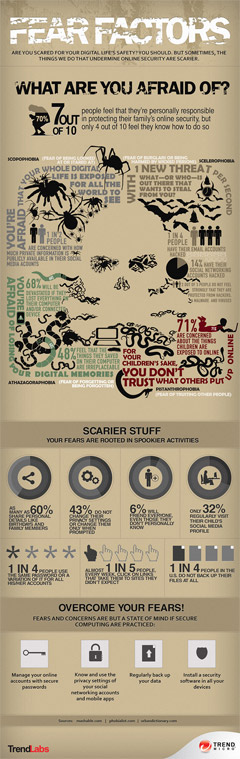
A infographic study based on a Trend Micro survey sent to 1,000 respondents in the United States, United Kingdom, and Australia found that one in four of us know how to protect our data from online security, while 7 out of 10 users feel that security measures lie within them to protect their personal and family identity.
Biggest Fear Factor
The biggest fear factors for them are fear of being looked at, fear of being burglars or being harmed by wicked persons, fear of misplacing digital data and fear of trusting other people. Half of the respondents are concerned with how much private information is publicly available in their social networks accounts.
Near 14 percent feel that their email or social networking accounts are hacked and two out of three agreed that they are not totally protected from hackers, malwares and viruses. Moreover, almost three third of respondents are concerned about their digital data are being exposed to online by their children.
Alarming Figure
More than 60 percent of people are sharing personal information such as family members or birthdays online, and 43 percent don’t change their privacy settings or change them only when alerted. In addition, only 32 percent keep tabs on their children’s social media profiles and only six percent share their online profile to everyone.
More alarmingly, one in four of respondents use the same password or a variation of it for all their social and personal accounts. One in four people in the U.S. also don’t bother to back up files.
Security Measures
Security doubts have been a constant barrier holding back wider adoption of social services and is cited as one of the main reasons for many users.
Trend Micro suggested taking steps to protect ourselves. Step one is to manage your online accounts with secure passwords. It is advisable that passwords should contain letters, numbers, and symbols when possible. Step two is to know and use the privacy setting of all your accounts wisely. Virtually every social media services and apps have privacy settings and if you don’t want just anyone to have access to your Facebook or Twitter feed, lock it down!
Step three is to regularly back up all your data. Any backup services are capable of back your data up online automatically. And lastly, install security software on your computers, smartphones, laptops, and tablets with a software solution that actively protects us from threats.
… We’d like to tell you about our mission and how you can help us fulfill it. SiliconANGLE Media Inc.’s business model is based on the intrinsic value of the content, not advertising. Unlike many online publications, we don’t have a paywall or run banner advertising, because we want to keep our journalism open, without influence or the need to chase traffic.The journalism, reporting and commentary on SiliconANGLE — along with live, unscripted video from our Silicon Valley studio and globe-trotting video teams at theCUBE — take a lot of hard work, time and money. Keeping the quality high requires the support of sponsors who are aligned with our vision of ad-free journalism content.
If you like the reporting, video interviews and other ad-free content here, please take a moment to check out a sample of the video content supported by our sponsors, tweet your support, and keep coming back to SiliconANGLE.






