




 Dell’s days as a publicly traded company may soon come to an end, as rumor surfaced of the world’s third-largest maker of personal computers (PCs) is exploring a potential buyout with at least two private-equity firms.
This isn’t the first time Dell has been in serious talks with private-equity firms over a potential buyout deal. Three years ago Michael Dell hinted that the company may look at going private.
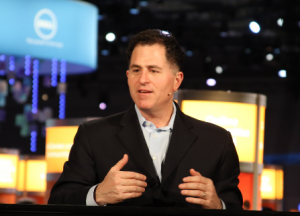
In the recently concluded Dell World, CEO Michael Dell told SiliconAngle that the IT world is changing, and Dell, because it does not have a huge legacy of hardware products to defend, is in a near-ideal position to capitalize. Without a massive legacy of old technology, Dell is in a perfect position to help customers convert to advanced technologies like software-defined networking (SDN), virtualized data centers, and cloud services.
Although there is no guarantee that a deal will take place, a privately held Dell would make sense for the company.
When Michael Dell took back the chief executive role in 2007 after serving as chairman, he had a bigger role to revive the company’s fortune. He has since then worked hard to diversify the company’s revenues, entering into new cloud-computing and storage businesses, and making plenty of acquisitions along the way.
But Dell’s core desktop PCs and mobile computer divisions both continue to shrink in the face of Android and iPad tablets. Over the past 12 months Dell’s shares have fallen by almost a third as investors’ faith in the company has been shaken. Dell has lost shares to local rival Hewlett-Packard, as well as China’s Lenovo.
IDC reported sales of PCs fell over the holiday period for the first time in more than five years, and worldwide PC shipments shrank 6.4%. Overall, the company’s PC shipments were down 12.3 percent last year as its desktop PCs and laptops fail to grab the public’s attention.
A private move would mean the company would no longer have to answer to shareholders and move away from the consumer PC market into more profitable data center business. Dell purchased Quest Software last year, which make software for data centers and also provides big data analytics solutions.
The PC manufacturer wants to sell systems with higher added value, combining hardware and software for a new and improved datacenter infrastructure.
Dell’s strong position in the corporate computing world could be very attractive for the company to explore, as it works on expanding or solidifying its business in cloud computing and big data markets.
Dell’s servers and networking division is growing, which would help the company to grow in the area of SaaS and software-led infrastructure. The fact that Dell still has billions of dollars of cash in its coffers, the company’s strategy of bulking up its cloud-based services will be easier to execute.
Dell also has the option to take advantage of its healthy balance sheet for strategic purposes, something that other net debt hardware names cannot claim in their favor.
Wikibon Co-founder and CTO David Floyer agrees, noting that the string of networking and software acquisitions Dell’s made in recent years puts the company in a good position moving forward. It’s now a matter of integrating these freshly acquired components to balance out its portfolio. See Floyer’s full analysis below:
A buyout would probably help the company’s prospects for future growth. The company will get a chance to retool its products away from hardware and towards enterprise technology and consulting.
The company is already experimenting with cloud computing and converged infrastructure offerings, and its growing dependence on the corporate enterprise business might help Dell to become a pure software vendor. Dell-based technology offers compute power, storage, connectivity, networking and an entire management layer for a complete solution for the customer.
… We’d like to tell you about our mission and how you can help us fulfill it. SiliconANGLE Media Inc.’s business model is based on the intrinsic value of the content, not advertising. Unlike many online publications, we don’t have a paywall or run banner advertising, because we want to keep our journalism open, without influence or the need to chase traffic.The journalism, reporting and commentary on SiliconANGLE — along with live, unscripted video from our Silicon Valley studio and globe-trotting video teams at theCUBE — take a lot of hard work, time and money. Keeping the quality high requires the support of sponsors who are aligned with our vision of ad-free journalism content.
If you like the reporting, video interviews and other ad-free content here, please take a moment to check out a sample of the video content supported by our sponsors, tweet your support, and keep coming back to SiliconANGLE.






