



 NEWS
NEWS
NEWS
NEWS
NEWS


Guest post from Brian Shih, Former Google Reader Product Manager.
I left Google in 2011 so this is all my own speculation. I have no idea if this is the real reason or not, and there certainly could be more to the story. Don’t take my word as gospel.
Having said that, let’s be clear that this has nothing to do with revenue vs operating costs. Reader never made money directly (though you could maybe attribute some of Feedburner and AdSense for Feeds usage to it), and it wasn’t the goal of the product.
Reader has been fighting for approval/survival at Google since long before I was a PM for the product. I’m pretty sure Reader was threatened with de-staffing at least three times before it actually happened. It was often for some reason related to social:
It turns out they decided to kill it anyway in 2010, even though most of the engineers opted against joining G+. Ironically, I think the reason Google always wanted to pull the Reader team off to build these other social products was that the Reader team actually understood social (and tried a lot of experiments over the years that informed the larger social features at the company)[1]. Reader’s social features also evolved very organically in response to users, instead of being designed top-down like some of Google’s other efforts[2].
I suspect that it survived for some time after being put into maintenance because they believed it could still be a useful source of content into G+. Reader users were always voracious consumers of content, and many of them filtered and shared a great deal of it.
But after switching the sharing features over to G+ (the so called “share-pocalypse”) along with the redesigned UI, my guess is that usage just started to fall – particularly around sharing. I know that my sharing basically stopped completely once the redesign happened [3]. Though Google did ultimately fix a lot of the UI issues, the sharing (and therefore content going into G+) would never recover.
So with dwindling usefulness to G+, (likely) dwindling or flattening usage due to being in maintenance, and Google’s big drive to focus in the last couple of years, what choice was there but to kill the product?
Personally, I think that there is still a lot of value a service like Reader could provide — particularly in a world with increasing information overload coming us from many different sources. But Reader at Google was pigeonholed as an RSS-reader explicitly, and didn’t have a chance to grow beyond that to explore that space. But that’s neither here nor there.
[1] See Reader’s friends implementations v1, v2, and v3, comments, privacy controls, and sharing features. Actually wait, you can’t see those anymore, since they were all ripped out.
[2] Rob Fishman‘s Buzzfeed article has good coverage of this: Google’s Lost Social Network
[3] Reader redesign: Terrible decision, or worst decision? I was a lot angrier then than I am now — now I’m just sad.
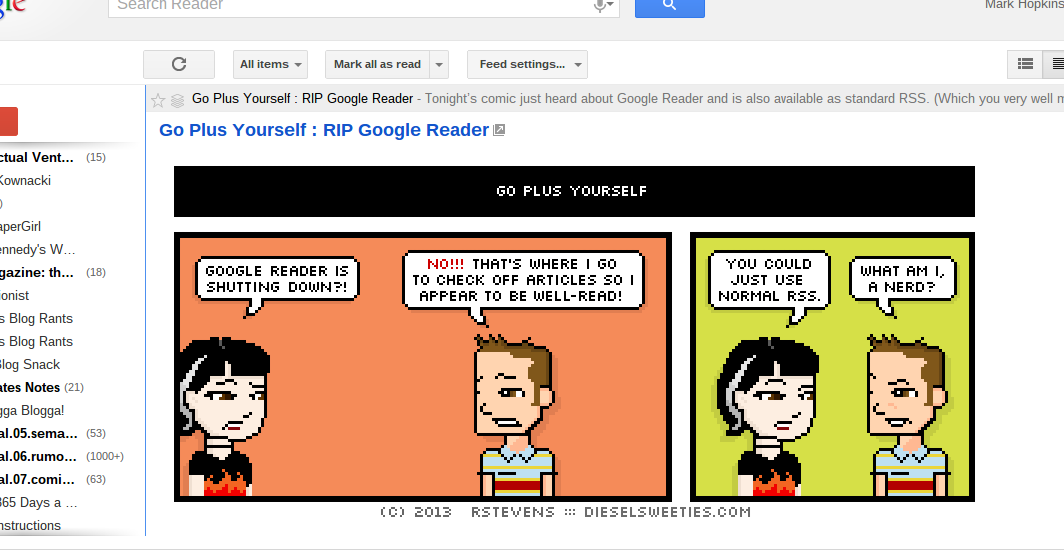
[Editor’s Note: Cross-posted from Quora. Comic in the feature image is today’s Diesel Sweeties by rstevens, as I found it in Google Reader. -mrh]
… We’d like to tell you about our mission and how you can help us fulfill it. SiliconANGLE Media Inc.’s business model is based on the intrinsic value of the content, not advertising. Unlike many online publications, we don’t have a paywall or run banner advertising, because we want to keep our journalism open, without influence or the need to chase traffic.The journalism, reporting and commentary on SiliconANGLE — along with live, unscripted video from our Silicon Valley studio and globe-trotting video teams at theCUBE — take a lot of hard work, time and money. Keeping the quality high requires the support of sponsors who are aligned with our vision of ad-free journalism content.
If you like the reporting, video interviews and other ad-free content here, please take a moment to check out a sample of the video content supported by our sponsors, tweet your support, and keep coming back to SiliconANGLE.






