





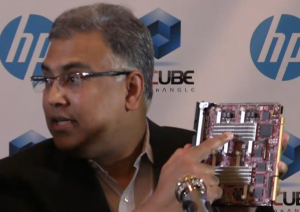
 If there is one takeaway you’ll have from our coverage of HP’s Moonshot announcement it is this: less is more. In an emerging market for software-defined infrastructure we hear AMD’s Corporate Vice President and General Manager, Server Business Suresh Gopalakrishnan, who was a guest on theCube today during HP’s Moonshot launch event. Hosts John Furrier (Founder, SiliconANGLE) and Dave Vellante (Chief Analyst, Wikibon) talked shop on just about everything software-defined, from the perks of HP’s Moonshot, and the growing interest in Software Defined “X” applications, with Gopalakrishnan.
“If density wasn’t an issue, you could build bigger boards — chips talking to other chips expand energy,” said Gopalakrishnan. Every 1 million servers basically takes a power plant to run, so as Gopalakrishnan indicates, density is absolutely an issue. With the Moonshot announcement, HP is attacking this issue head on, and with notable partners too, including AMD, Applied Micro, Texas Instruments, and Calxeda. The Software-defined data center is a term you’re going to hear coined along with all of the other software-defined industries, whatever they’re to be called, becoming a real destination for the server space.
Gopalakrishnan had a theme that he carried throughout his interview with Furrier and Vellante that I’d like to point out; “software is the gatekeeper to hyperscale.” Let me first define hyperscale: the computing infrastructure and provisioning needed in distributed computing environments for effectively scaling from several servers to thousands of servers. Oftentimes it is directly employed in environments like cloud computing and Big Data. Basically, hyperscale is the server version of the hockey-stick-growth model.
What is interesting to extract from this interview is Gopalakrishnan’s opinion, which I’m inclined to agree with 100 percent, that the maturation of hyperscale technology depends entirely on the software. Enterprises depend heavily on software, making it a priority in the resource lineup. If software is eating the world, then software-lead infrastructure is an accelerator to a hungry appetite. Software is tuning systems to match the workload, as opposed to the workload to match the systems. Infrastructure as we once knew it is completely changing.
AMD has been participant of the Pathfinder Innovation Ecosystem since 2011. Its primary focus in the ecosystem is to bring the right kind of CPU (Central Processing Unit) and GPU (Graphic Processing Unit) workloads together. When asked to explain what the Moonshot announcement meant to the server industry Gopalakrishnan said, “…for folks whose workloads are very scale-out oriented, this is the right platform to go with.”
… We’d like to tell you about our mission and how you can help us fulfill it. SiliconANGLE Media Inc.’s business model is based on the intrinsic value of the content, not advertising. Unlike many online publications, we don’t have a paywall or run banner advertising, because we want to keep our journalism open, without influence or the need to chase traffic.The journalism, reporting and commentary on SiliconANGLE — along with live, unscripted video from our Silicon Valley studio and globe-trotting video teams at theCUBE — take a lot of hard work, time and money. Keeping the quality high requires the support of sponsors who are aligned with our vision of ad-free journalism content.
If you like the reporting, video interviews and other ad-free content here, please take a moment to check out a sample of the video content supported by our sponsors, tweet your support, and keep coming back to SiliconANGLE.






