




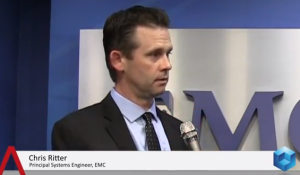
 Wikibon co-founder and chief analyst Dave Vellante caught up with Chris Ritter, a principal systems engineer for EMC, during the EMC SAP Week meeting at the company’s EBC headquarters in Hopkinton, MA. The two discussed virtualization and Amazon Web Services, the other elephant in the room (full video below).
Vellante starts the interview by asking Ritter about his role within EMC. Ritter states that his job is to help users realize the best possible return on the integrated solutions that his firm develops and sells in collaboration with Cisco, VCE and VMware.
Vellante recalls speaking to EMC chief strategist and Pivotal Initiative head Paul Maritz at an analyst conference a few years ago, when he still served as CEO of VMware. The executive told him that his goal for the company is to deliver software that can run any application anytime with no performance or SLA degradation; an objective that Ritter says has since been met.
He explains that continuous software optimization has the infamous virtualization tax so negligible that the advantages far outweigh the cost. He adds that the native APIs included in the hypervisor go all the way down to the networking layer and enable advanced business continuity and parallel work stream functionality.
Ritter goes on to talk about virtualization adoption. He says that while the transition from physical to virtual is relatively simple, other scenarios such as migration from RISC-based infrastructure to an x86 environment are more complicated. Most VMware users try to keep their business processors intact, but many applications are rewritten to take full advantage of new functionality.
After briefly going the HR implications of adopting virtualization, Ritter addresses Amazon. He tells Vellante that AWS is not suitable for running enterprise-scale mission-critical apps, and adds that private cloud environments often prove to be more cost-effective on the long run.
See Ritter’s entire commentary in the video below.
… We’d like to tell you about our mission and how you can help us fulfill it. SiliconANGLE Media Inc.’s business model is based on the intrinsic value of the content, not advertising. Unlike many online publications, we don’t have a paywall or run banner advertising, because we want to keep our journalism open, without influence or the need to chase traffic.The journalism, reporting and commentary on SiliconANGLE — along with live, unscripted video from our Silicon Valley studio and globe-trotting video teams at theCUBE — take a lot of hard work, time and money. Keeping the quality high requires the support of sponsors who are aligned with our vision of ad-free journalism content.
If you like the reporting, video interviews and other ad-free content here, please take a moment to check out a sample of the video content supported by our sponsors, tweet your support, and keep coming back to SiliconANGLE.






