





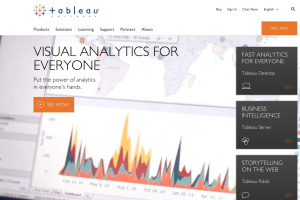
 Now that Tableau’s cash flow has increased after a successful debut at the NYSE, the data visualization company is expected to have the ability to build out its enterprise solutions and generate even more revenue. According to Wikibon analyst Jeff Kelly, Tableau is seen as more of a toy than a tool, so the IPO money raised will be used to build out its enterprise capabilities as part of a broader strategy. This means better security, enhanced self-service offerings to add more management controls, and also more promotion for the brand.
But if you ask Tableau, the company is already well positioned for the enterprise. Despite Tableau’s upbringing in the academic space, the underlying technology won’t need much tweaking to further pursue the enterprise. In fact, Tableau already has enterprise offerings working from the same concepts and capabilities behind its consumer-facing products like Tableau Public, for journalists and bloggers.
I expect Tableau’s maturation in the data visualization market will lead to more differentation amongst its product portfolio, better distinguishing enterprise and consumer offerings, but don’t expect Tableau to follow the same consumer-to-enterprise path we’ve seen from other cloud platforms like Dropbox (to be fair, it’s just the distribution method I’m comparing, not the products).
 “There would be differentiation over time, but [Tableau’s] core technology stays the same – the ability to compute data and create gorgeous interactive experiences,” says Jock Mackinlay, Software Director of Visual Analysis at Tableau.
You can thank Tableau’s company mission for the planned path to enterprise domination, which remains the same for all users and clients — Help people see and understand data. Such a goal of data democratization is much needed in the enterprise, even beyond visualization. But the visual aspect of data consumption is key for end-user compatibility and access, demonstrating the intrinsic value of Tableau’s role in the industrialization of the Internet.
In regards to the Internet of Things, “there’s a close relationship with that and the data democratization we’re part of,” Mackinlay explains. “My background in particular — I joined Tableau from the research world, using visuals to understand data. At Tableau we couple that with an easy-to-use interface. That means anyone with data they’re interested in can use data to answer questions.
“When Tableau started it was from a Stanford project. A key innovation was turning data views into queries on databases… So we’ve always operated in a space that’s both consumer-centric and commercial, and you can understand data whether you have a database or not. That’s what we’ve done so well — you can work [with Tableau] as an individual or an organization.”
Contributors: Amber Harris
… We’d like to tell you about our mission and how you can help us fulfill it. SiliconANGLE Media Inc.’s business model is based on the intrinsic value of the content, not advertising. Unlike many online publications, we don’t have a paywall or run banner advertising, because we want to keep our journalism open, without influence or the need to chase traffic.The journalism, reporting and commentary on SiliconANGLE — along with live, unscripted video from our Silicon Valley studio and globe-trotting video teams at theCUBE — take a lot of hard work, time and money. Keeping the quality high requires the support of sponsors who are aligned with our vision of ad-free journalism content.
If you like the reporting, video interviews and other ad-free content here, please take a moment to check out a sample of the video content supported by our sponsors, tweet your support, and keep coming back to SiliconANGLE.






