



 NEWS
NEWS
NEWS
NEWS
NEWS

 Portland-based startup Orchestrate has launched a commercial product for NoSQL that provides a developer-friendly service for managing data across multiple regions and cloud providers. This makes it suited to companies with concerns about complexity and interest in rapid app development.
Database issues arise constantly. Over the years, companies like Amazon and Google have reached current database technology limits and were forced to develop new types of suitable for large volume of requests. As a result, much time was spent trying to improve these changes and make applications work fine.
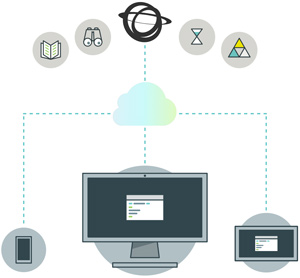
Orchestrate acts as a service within a service, abstracting from the DB layer to eliminate issues arising on rapid app development. The Database-as-a-Service company performs the complex and tedious task of supporting multiple databases and put them in API, which programmers can use to build applications more quickly.
Available to try for free, the commercial product unifies all the queries needed to build interactive applications, such as geospatial, time-series, graph, full-text search, key-value queries and more through a single API. The product eliminates the operational and financial burden on enterprises that run multiple databases, such as monitoring and maintaining them, scaling as usage grows, and distributing them across providers to improve fault tolerance and put data closer to end users. As a result, developers can focus on building richer, more sophisticated applications.

Fig 1.1: Example dashboard from the Orchestrate database management interface.
“We’ve witnessed businesses struggle to navigate the sometimes overwhelming NoSQL ecosystem time and again,” said Antony Falco, CEO and co-founder of Orchestrate. “The explosion of the database market has caused confusion for developers and added complexity to apps. At the same time, individual databases themselves don’t differentiate the product – user experience does. No app has ever come out on top because of how well they ran a database. Orchestrate simplifies multi-database management and frees developers to focus on building better products faster and without the headaches.”
As the complexity of operating databases has increased, most other parts of the stack have shifted to simpler, on-demand, API-driven services–compute, message queues, and object storage. It’s that capability to keep the data isolated which could prove valuable to companies.
The free version offers one million query operations per month, whereas the commercial version will start at $39 per month covering ad hoc search queries with Lucene, monitoring, data security, support, daily usage reports and daily backups into customer-designated and controlled locations. Orchestrate says client libraries for Java, Node.js, and Go, with Ruby, Python, .NET and other common languages will be released in coming days. The company last year raised $3 million in seed funding to build out infrastructure and add support for multiple cloud providers.
… We’d like to tell you about our mission and how you can help us fulfill it. SiliconANGLE Media Inc.’s business model is based on the intrinsic value of the content, not advertising. Unlike many online publications, we don’t have a paywall or run banner advertising, because we want to keep our journalism open, without influence or the need to chase traffic.The journalism, reporting and commentary on SiliconANGLE — along with live, unscripted video from our Silicon Valley studio and globe-trotting video teams at theCUBE — take a lot of hard work, time and money. Keeping the quality high requires the support of sponsors who are aligned with our vision of ad-free journalism content.
If you like the reporting, video interviews and other ad-free content here, please take a moment to check out a sample of the video content supported by our sponsors, tweet your support, and keep coming back to SiliconANGLE.






