





This week’s Quantified Self roundup features a tough-loving fitness app, an app that tracks your life through quizzes, and an API to help make sense of the huge amounts of Quantified Self data.
.
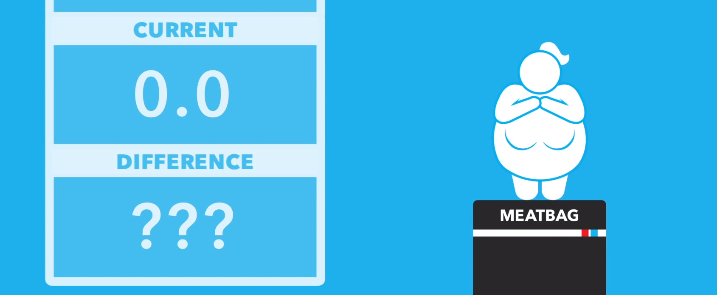
If you find it hard to lose weight because you lack motivation then the CARROT Fit – Talking Weight Tracker may help you achieve your goal. Unlike other fitness or health trackers, it doesn’t give out positive responses to motivate you, what it does is resort to name calling and judging your weight. In other words, this chatty tracker dishes out some tough love to get you moving and shedding those pounds.
Upon downloading the app, you’ll be presented with the app’s mission which is to get you from flab to fab, and you have to thank it for taking on the impossible task. It will then guess your weight which will probably be about 300 to 500 pounds more than what your current weight is. It will then ask if you agree or disagree with the estimate, and if you disagree, it will laugh in your face before asking you to input your weight, which is represented by an avatar. After that the app shows you what happens if you start losing weight or gaining pounds. Lose weight and you’ll be showered with gifts such as exercise tips or cute photos of cats; gain weight and prepare to cry with the onslaught of insults.

image source: ReporterApp
If you want to start monitoring various aspects of your life, but don’t know where to start, the Reporter App may help you get on the right track. Most lifelogging apps require you to log every activity you partake, which, to be honest, is often something people forget to do. What makes the Reporter App standout is that it asks you questions at random times throughout the day so you’re logging things that may seem trivial, but could give insight to aspects of your life that are often ignored or sometimes deemed unmeasurable.
It’s a fun way of tracking your daily activities if you don’t mind getting asked to answer some questions at random times. Others have found the $4 app to be really useful, but some have already pointed out that this app just gathers your answers without actually giving you real insight to your life. You can’t compare two data sets which means you can’t find the correlation between them. Also, for $4, some do not see this app as something that’s worth downloading.
SwiftIQ, the company that provides web-service application programming interface (API) infrastructure to facilitate data accessibility and adaptive, machine learning predictions, released a first-of-its-kind data mining API that aims to uncover deep associations hidden behind large data sets.

image source: SwiftIQ
Dubbed the Frequent Pattern Mining (FPM) API, it has wide potential for use in various sectors such as the government, healthcare, or even the Quantified Self revolution.
“Frequent Pattern Mining is a new algorithm in the Swift Predictions catalog,” Jason Lobel, CEO and Co Founder of SwiftIQ said in an interview. “It is an algorithm for mining big data to quickly discover all the permutations that might occur within a large dataset. It runs on Hadoop in the cloud as an on-demand service. FPM results are then stored and can be searched across tens of millions of records instantly. You can even visualize and embed the results via our d3-based JavaScript library for simple interpretation. These insights extend the realm of human capabilities by unearthing complex relationships as needed.”
Timothy Ferriss, life-hacker and The 4-Hour Chef author, is currently working with the Lift app team and UC Berkeley to study dietary habits using quantified self data gathered from participants.
“If variables like weather, mood, activities, and diet are tracked by these apps, the FPM API provided by SwiftIQ can identify relationships between these behaviors,” added Lobel.
… We’d like to tell you about our mission and how you can help us fulfill it. SiliconANGLE Media Inc.’s business model is based on the intrinsic value of the content, not advertising. Unlike many online publications, we don’t have a paywall or run banner advertising, because we want to keep our journalism open, without influence or the need to chase traffic.The journalism, reporting and commentary on SiliconANGLE — along with live, unscripted video from our Silicon Valley studio and globe-trotting video teams at theCUBE — take a lot of hard work, time and money. Keeping the quality high requires the support of sponsors who are aligned with our vision of ad-free journalism content.
If you like the reporting, video interviews and other ad-free content here, please take a moment to check out a sample of the video content supported by our sponsors, tweet your support, and keep coming back to SiliconANGLE.






