







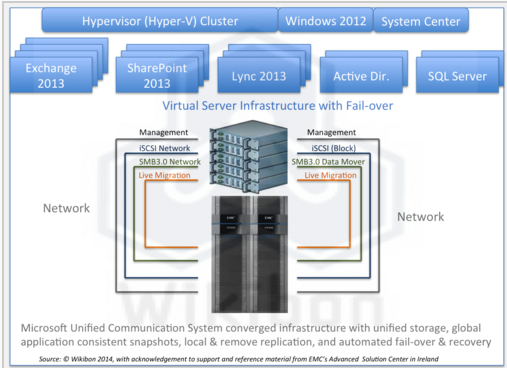
 The functionality and performance improvements of Microsoft Exchange 2013, SharePoint 2013 and Linc 2013, on top of Windows 2012, create compelling arguments for business and government users to upgrade to Windows Unified Communications 2013 as soon as possible, writes Wikibon CTO and Cofounder David Floyer in “Duplicating Public Cloud Economics for Microsoft Unified Communications”. While Office 365, Microsoft’s Software-as-a-Service (SaaS) offering, also includes all the components of UC 2013, Wikibon’s analysis of the fully loaded costs, including internal support costs and significant extra costs integrating it with Active Directory, some of which are not included in Microsoft’s published cost comparison, make it the more expensive option over time for organizations with more than 300 seats. Also, he writes, cloud services almost always provide slower average response rates than internal installations, hurting productivity. Therefore, he recommends internal installation for organizations with more than 300 seats unless they have insufficient CapEx budgets and available OpEx to cover the monthly cost of Windows 365.
Compared to the previous version of UC, the new version provides significant productivity improvements, much more than necessary to justify the extra hardware costs required, Floyer writes. He reports that the productivity improvement break-even point requires times savings of 0.5 percent over the previous version while end-users are actively using Microsoft UC 2013, or 0.05 percent of total time employees spend at their jobs, the equivalent of saving 14 seconds per day per employee.
Wikibon’s research predicts a likely improvement of 5 percent per user from UC 2013 during active use. Based on the assumption that average active use of UC is about 10 percent of overall employee work time, migrating to UC 2013 has a ROI of more than 300 percent and a break-even point of less than four months, making the decision to upgrade the ultimate no-brainer.
Based on these figures and interviews with Wikibon members, Floyer urges CIOs to move their companies to UC 2013 as quickly as possible to avoid the danger that division or department heads may move their units to the more expensive Office 365 option independently to achieve the productivity gains that the new features provide.
XXXX
 Because of the integration of all three packages, and the requirement to integrate with other services such as Active Directory, Wikibon sees virtualization of UC 2013 as best practice. Its research shows that Microsoft’s virtualization engine, Hyper-V, together with Systems Center, is sufficiently robust to be a component of an integrated UC solution.
One common question raised by Wikibon members is whether it is necessary to use direct-attached storage (DAS) with UC 2013, which Microsoft recommends, rather than a SAN, which is the universal storage architecture in larger IT shops. Wikibon’s research shows it is reasonable at low seat counts to use DAS. However, neither SharePoint 2013 or Lync 2013 lack the built-in high-availability design of Exchange 2013, which is necessary to maximize the performance improvements from DAS over SAN, and both use the Microsoft SQL Server database. Wikibon also found that traditional arrays were still cheaper than DAS. Wikibon members report that UC 2013 operates well on a SAN network. Therefore, Wikibon’s recommendation to larger shops is to run UC 2013 over their SAN networks rather than bringing in a special architecture. Wikibon also finds that at the very low-end, Office 365 is likely to be a cheaper alternative to using an in-house DAS-based solution.
As with all Wikibon research, Floyer’s full report is available without charge on the Wikibon Web site. IT professionals are invited to register for free membership in the Wikibon community. This allows them to participate in Wikibon research, pose questions, and publish their own comments, tips, Professional Alerts and longer research on the site for other members.
Support our mission to keep content open and free by engaging with theCUBE community. Join theCUBE’s Alumni Trust Network, where technology leaders connect, share intelligence and create opportunities.
Founded by tech visionaries John Furrier and Dave Vellante, SiliconANGLE Media has built a dynamic ecosystem of industry-leading digital media brands that reach 15+ million elite tech professionals. Our new proprietary theCUBE AI Video Cloud is breaking ground in audience interaction, leveraging theCUBEai.com neural network to help technology companies make data-driven decisions and stay at the forefront of industry conversations.




