





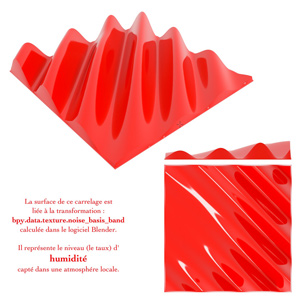
 Imagine a 3D printer which becomes integrated platform visualization. That is what a company called FABMOB (stands for fabrication + mobility, site is in French) is developing a 3D system, where it collects atmospheric information and converts it into 3D printed objects. According to FABMOB, data can be very boring and confusing unless it is visualized in a good way. And that’s exactly what they are trying to achieve with this project.
The device was produced for Défi Data+, an international contest for functional prototypes related to digital manufacturing and the Internet of Things, and the production of tangible representations of data.
How it works
The FABMOB machine monitors various aspects of the Earth through time, location, light, temperature, humidity and noise. Next the data is extracted by an algorithm over a short period of time, which converts it into small tiles called ATMOStags (atmosphere + tag), which can be instant markers for information that’s not normally visible. The result is a small square that even the most resembles an uneven bathroom tile. However, the tile contains all collected information from an atmospheric sensor sweep.
Each ATMOStag tile has its own website hosted by the organization Smart Citizen. Smart Citizen is an organization that is trying to monitor the environment and using this information, they want to create a searchable database. The website contains all the information that is visualized by the tile. Next, it is intended that the ATMOStag be deposited in the appropriate location so everyone can see how the earth looks like in 3D object. After you print it out, you mount it at the print site, effectively representing the environmental conditions of the surrounding area through a colorful, textured shard.
Each specific URL contains all the information matching physical objects. When you print out these same chip as the tile surface, which can naturally be embedded in floors, walls or other places. Of course, FABMOB application also allows users to create their own ATMOStag. FABMOB says ATMOStag is an act of public design, a gesture of urban communication, an example of contemporary generative practices and a singular expression of the convergence of art, science and technology.
“ATMOStag tiles are installed in the environment from which the data that generated them, was captured. They mark a place, an instant and a synthesis of those environmental qualities. By representing that which cannot otherwise be seen, ATMOStag is an act of public design, a gesture of urban communication, an example of contemporary generative practices and a singular expression of the convergence of art, science and technology,” says the company.
The surface geometry of an ATMOStag tile is generated by the 3D modeling and animation software Blender, which is based on the programming language Python. The light, humidity, temperature, CO, NO2, noise and other data captured by ATMOStag is converted into 3D transformation using this Python code. You can then send the 3D printed object via Wi-Fi or 4G.
[Top image credit: FABMOB, humidity readout 3d print from fabmobs.com]
… We’d like to tell you about our mission and how you can help us fulfill it. SiliconANGLE Media Inc.’s business model is based on the intrinsic value of the content, not advertising. Unlike many online publications, we don’t have a paywall or run banner advertising, because we want to keep our journalism open, without influence or the need to chase traffic.The journalism, reporting and commentary on SiliconANGLE — along with live, unscripted video from our Silicon Valley studio and globe-trotting video teams at theCUBE — take a lot of hard work, time and money. Keeping the quality high requires the support of sponsors who are aligned with our vision of ad-free journalism content.
If you like the reporting, video interviews and other ad-free content here, please take a moment to check out a sample of the video content supported by our sponsors, tweet your support, and keep coming back to SiliconANGLE.






