




by Anne Ward Last week, Box announced their intentions to file for IPO. This comes on the heels of Google’s announcement a couple weeks ago that they will offer one terabyte (TB) of data for only $9.99 a month. Both announcements have had a chilling effect in Silicon Valley and beyond, because it could easily put smaller cloud storage players out of business. It probably will. From Dropbox to Microsoft, many are shaking in their E-boots. Cloud  hosting has seemingly become a commodity, now. But has it, really? Each cloud hosting provider has some type of bell or whistle unique to their own user base. Box’s bold move will no doubt inspire other cloud players to move forward with their IPOs. All of the recent chatter surrounding both announcements reminds me of Kryder’s Law, which was inspired by the work of the great Mark Kryder, Fellow of both APS and IEEE. In his law he draws upon Moore’s law to explain that magnetic hard disk density is increasing ever so quickly. The pace for hard disk density is growing far faster than semiconductor performance ever could. The end result is not going to be a risk for consumers, but rather for providers. Imagine you’ve built a cloud storage business, every two years your hardware causes you to take a 50% hair cut. The inevitable drum beat of time means that every two years the quality of your offering is half as good as it was before. There are only a handful of providers that can weather through a two year blip.
Business processes are moving en masse towards the cloud, I don’t think most people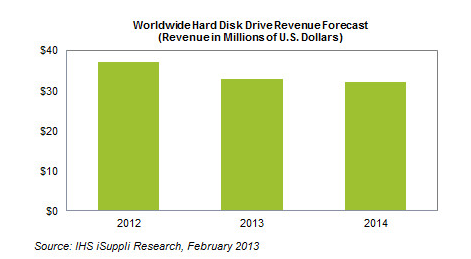 would argue this point… According to a report issued by IHS iSuppli in 2013, HDD sales were down $32.7 billion globally, which is a 12% drop from the year prior. This trend is expected to only increase. We’re no longer storing locally on hard drives, we’re storing globally. Since cloud collaboration is essential to business, it will be interesting to see where this will lead us. Doing business outside of the cloud is akin to performing business functions via fax. While technically it can work, but is that the best way to get things done? Google’s $10 terabyte offering is going to shake things up so much that I believe the industry will start to shift. But where to, you may ask?
When something becomes a commodity the key differentiator for success can be an increase in the quality of service. We don’t often realize it, but there are a variety of cloud services we all use independently; the functions range from accounting to storing photos to keeping lists of sales prospects (CRM). APIs galore will need to be built in order to string all of our processes together. Cloud services management will soon become the new and hip business problem to solve (rather than adoption). Most people want and need fewer logins along with the ability to trust in their respective providers to store things securely. Companies will have to begin thinking about the various services they will connect with. Just like traditional POTs lines getting upgraded to VoIP, the telephony concepts match up for what seems like an easy upgrade, but the actual implementation of making the conversion is far behind. Have you ever wondered how Airbnb allows a potential guest to  call their future host through the site? That’s with an API. The layers of conversion needed are why companies like Twilio and Nexmo have come to exist. Both companies provide the web APIs that string together Voice and SMS applications. This is just the start. The ability to connect stored data to a wide variety of services will become paramount. A platform called SimpleECM has announced an API platform focused on document management and workflows. Enabling the flow of documents across cloud storage and other processing services means that enterprises can rethink how they capture, classify and intelligently store documents (data) in one or more cloud storage services. This data is no longer at rest, it’s used to create workflows and automated processes that integrate into HR, CRM, ERP and other business systems. Salesforce.com has accomplished something similar with a vibrant ecosystem of development partners to move customer data into other applications. There would be no jumping from one cloud service to another; they’d just talk to one another. A company could integrate cloud services the way they want to, regardless of providers. This brings the power back to the people! I believe that we will come to expect more from our cloud services, they will need to function like an in-house employee rather than a remote contractor. Time must be saved, efficiencies found. The bells and whistles will become increasingly important to us and we can (hopefully) expect to have fewer logins. The winner of this battle will be the companies who are looking to collaborate, because they will enjoy the spoils of war.
… We’d like to tell you about our mission and how you can help us fulfill it. SiliconANGLE Media Inc.’s business model is based on the intrinsic value of the content, not advertising. Unlike many online publications, we don’t have a paywall or run banner advertising, because we want to keep our journalism open, without influence or the need to chase traffic.The journalism, reporting and commentary on SiliconANGLE — along with live, unscripted video from our Silicon Valley studio and globe-trotting video teams at theCUBE — take a lot of hard work, time and money. Keeping the quality high requires the support of sponsors who are aligned with our vision of ad-free journalism content.
If you like the reporting, video interviews and other ad-free content here, please take a moment to check out a sample of the video content supported by our sponsors, tweet your support, and keep coming back to SiliconANGLE.






