




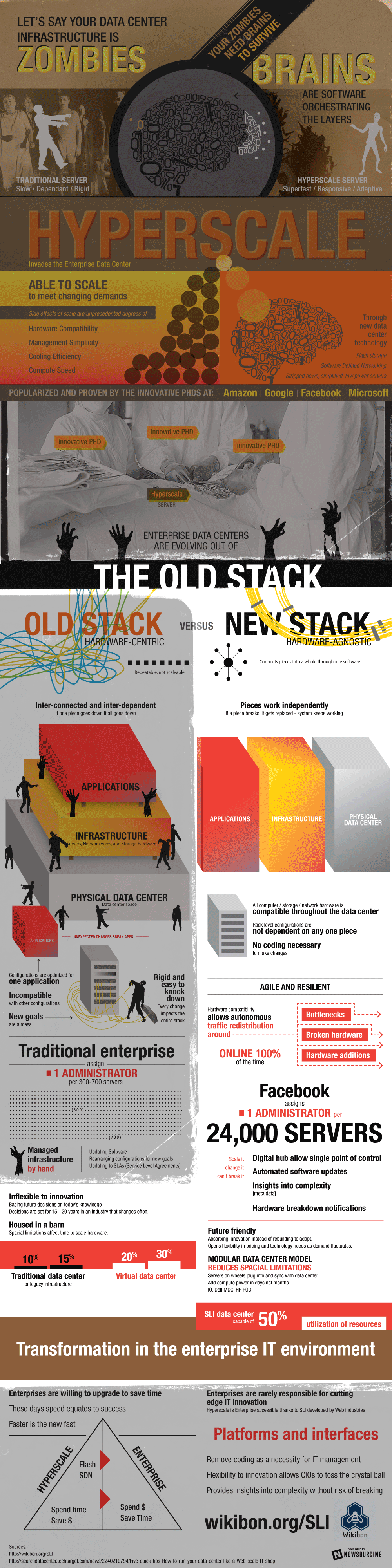
 Straining under the weight of more data than it was ever meant to handle, the traditional server-client architecture has turned slow and rigid. Judging by the rate at which digital information is growing, it should probably already be dead, yet it still keeps going, ever on the brink of system failure. It’s time for CIOs to give up on their zombie infrastructure and embrace the new reality of the software-defined data center, but the journey towards hyperscale is a long and bumpy one that will likely take years to complete, highlights the latest infographic from Wikibon.
Pioneered by Google, Amazon and other Internet giants that had encountered the challenges stemming from the data explosion years before their traditional enterprise peers, hyperscale holds the promise of greatly improved operational efficiency and increased management simplicity. Facebook, which is trying make the technology broadly accessible through its Open Compute Project, has achieved a ratio of 24,000 servers per administrator by abandoning proprietary hardware in favor of a modular architecture based on commodity components that can be easily and quickly replaced in the event of the failure with minimal impact on the overall health of the environment.
The secret sauce that turns x86 servers into a programmable pool of resources is software. By decoupling the management layer from the underlying hardware, it’s possible to provide a single point of control for an entire data center that not only automates many of the manual tasks involved in administering legacy infrastructure but enables deeper visibility as well, streamlining troubleshooting.
On top of everything else, the modular nature of the software-defined data center also takes the hassle out of upgrades, eliminating the need for costly and time-consuming rip-and-replace initiatives. Updates are installed automatically and more compute and storage capacity can be added in days instead of months.
See the full infographic below:
… We’d like to tell you about our mission and how you can help us fulfill it. SiliconANGLE Media Inc.’s business model is based on the intrinsic value of the content, not advertising. Unlike many online publications, we don’t have a paywall or run banner advertising, because we want to keep our journalism open, without influence or the need to chase traffic.The journalism, reporting and commentary on SiliconANGLE — along with live, unscripted video from our Silicon Valley studio and globe-trotting video teams at theCUBE — take a lot of hard work, time and money. Keeping the quality high requires the support of sponsors who are aligned with our vision of ad-free journalism content.
If you like the reporting, video interviews and other ad-free content here, please take a moment to check out a sample of the video content supported by our sponsors, tweet your support, and keep coming back to SiliconANGLE.






