



 NEWS
NEWS
NEWS
NEWS
NEWS


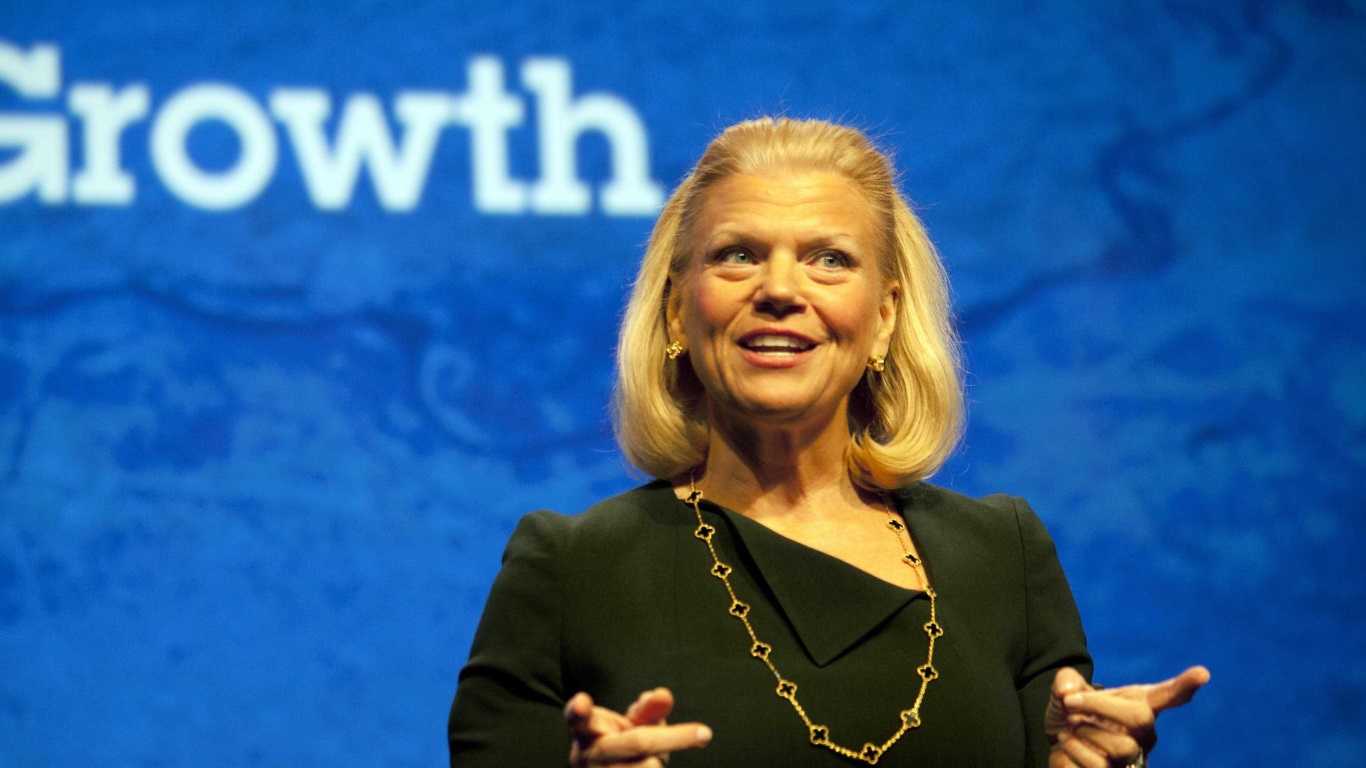
IBM CEO Ginni Rometty
After many months of wrangling, IBM finally managed to convince Globalfoundries Inc. to take over its unprofitable chip-making operations in a deal that will see Big Blue pay its long-time semiconductor supplier for the trouble rather than the other way around. The costly transaction marks a much-needed high point in the enterprise technology stalwart’s push to refocus on more lucrative markets such as cloud computing and analytics, a plan that CEO Virginia Rometty (right) is struggling to execute amid faltering revenue from legacy businesses.
That stagnation has made its mark on IBM’s third quarter sales, which tanked 4 percent to $22.4 billion in the tenth consecutive quarterly drop, sending the company’s share price plunging more than seven percent to a four-year low of $169. The poor performance is attributed to a 15 percent erosion in hardware income and reduced demand from emerging markets, namely Brazil, Russia, India and China, where Big Blue faces unusually stiff competition from government-endorsed local firms.
In stark contrast to its struggling legacy units, the vendor saw mobile revenue double – growth more reminiscent of a startup than a multi-billion dollar incumbent – while sales of cloud services rose a respectable 50 percent. Somewhat surprisingly, IBM’s analytics business, which the company has pushed heavily this year, grew only 9 percent. That’s not good news for Rometty, who has reportedly set a goal to grow the firm’s Watson cognitive computing 100-fold to 10 billion in within four years from $100 million in 2013.
Overall, however , Big Blue is making fast progress in its plans to transition into new growth areas. But the company will have to step up its efforts even further to truly become independent of its older businesses, which still make up roughly three-quarters of overall revenues. Rometty is attacking the problem from multiple angles, investing aggressively in promising divisions such the Watson group while scaling back on lower-profit areas, most notably hardware.
IBM’s commodity server business was the first to go. In January, the company revealed that it’s handing over its commodity machines to Lenovo Group Ltd., which had previously acquired its consumer devices group in 2005, for $2.3 billion. Eight months and a close run with US regulators later, the deal passed $200 million short of the original target price.
The newly revealed transfer of its semiconductor business to Globalfoundries ends an even more turbulent chapter in the company’s history. Following a month of speculation about a potential transaction, a report emerged in July suggesting that the deal fell through due to a refusal on IBM’s behalf to raise the price. It appears that IBM was just bargaining hard, however.
Under the newly signed agreement, which was revealed alongside Big Blue’s quarterly earnings, Globalfoundries will absorb the IT giant’s two chip manufacturing facilities in New York and Vermont along with its microelectronics unit in exchange for $1.5 billion to be paid over three years. Most employees will be given the option to stay in their current positions.
Taken together with the costs of discontinuing operations, the deal requires IBM to take a pre-tax charge of $4.7 billion in the third quarter, reducing net profits to a meager $18 million. But one-time expenses that carry long-term strategic value are easily excused on Wall Street. The much bigger concern for Rometty will be steering the firm into the era of cloud computing and analytics, which should prove slightly easier now that it’s one unprofitable semiconductor business lighter.
… We’d like to tell you about our mission and how you can help us fulfill it. SiliconANGLE Media Inc.’s business model is based on the intrinsic value of the content, not advertising. Unlike many online publications, we don’t have a paywall or run banner advertising, because we want to keep our journalism open, without influence or the need to chase traffic.The journalism, reporting and commentary on SiliconANGLE — along with live, unscripted video from our Silicon Valley studio and globe-trotting video teams at theCUBE — take a lot of hard work, time and money. Keeping the quality high requires the support of sponsors who are aligned with our vision of ad-free journalism content.
If you like the reporting, video interviews and other ad-free content here, please take a moment to check out a sample of the video content supported by our sponsors, tweet your support, and keep coming back to SiliconANGLE.






