



 NEWS
NEWS
NEWS
NEWS
NEWS

 Google has extended its Knowledge Graph into health with the search giant to offer curated medical answers in health search results.
The feature works like similar results from Google’s Knowledge Graph in where you ask a question and get an immediate result at the top of the search results, versus links to sites where you can get the information.
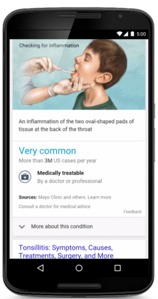
For example if you type in “what in Tonsillitis,” instead of getting links and maybe a dictionary definition, you’ll now get a larger amount of details (see picture right) including symptoms, treatment detail, how common the condition is and whether it’s critical, if it’s contagious, what ages it affects, and more.
Some conditions also offer high-quality illustrations from “licensed medical” illustrators.
Google Product Manager Prem Ramaswami said in a post on the Google Blog that Google had worked with a team of medical doctors “to carefully compile, curate, and review this information” and that “all of the gathered facts represent real-life clinical knowledge from these doctors and high-quality medical sources across the web, and the information has been checked by medical doctors at Google and the Mayo Clinic for accuracy.”
Ramaswami warned that Google is not a doctor, saying that this “doesn’t mean these search results are intended as medical advice.”
“We know that cases can vary in severity from person to person, and that there are bound to be exceptions. What we present is intended for informational purposes only—and you should always consult a healthcare professional if you have a medical concern.”
It’s a nifty feature; not everyone would know what Google’s Knowledge Graph is, but any Google user who regularly uses Google search has used it whether they intended to or not. From currency or measurement conversion through to breakout information on search results for the famous, and sometimes not so famous, it just makes Google’s search results so much quicker and more pleasant to use. The addition of health results is great for Google for users, although of note traffic to websites offering health information is likely to decline as a result.
The feature is being rolled out on Google.com (US English) in the next few days, with expansion globally to follow, although no time line was given.
Image credit: Google.
… We’d like to tell you about our mission and how you can help us fulfill it. SiliconANGLE Media Inc.’s business model is based on the intrinsic value of the content, not advertising. Unlike many online publications, we don’t have a paywall or run banner advertising, because we want to keep our journalism open, without influence or the need to chase traffic.The journalism, reporting and commentary on SiliconANGLE — along with live, unscripted video from our Silicon Valley studio and globe-trotting video teams at theCUBE — take a lot of hard work, time and money. Keeping the quality high requires the support of sponsors who are aligned with our vision of ad-free journalism content.
If you like the reporting, video interviews and other ad-free content here, please take a moment to check out a sample of the video content supported by our sponsors, tweet your support, and keep coming back to SiliconANGLE.






