







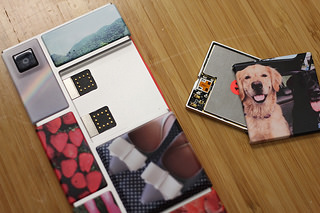
 Google Inc.’s Project Ara, a modular smartphone with interchangeable components, is based on an open platform that allows third-party vendors to create modules for the phone. One such third-party vendor, Toshiba Corporation, has unveiled its plans for interchangeable camera modules for the platform.
The camera on Google’s Ara modular smartphone is a self-contained module that can be swapped out for alternatives. This allows budding smartphone photographers to purchase better cameras without replacing the entire phone.
Toshiba unveiled its plans for building three different camera modules for Project Ara at the Modular Phones Forum. The company is working on a both 5 megapixel and 13 megapixel rear-facing camera modules, as well a 2 megapixel front-facing camera module.
These demo camera modules are part of the first of a three-stage development plan Toshiba hopes to complete during 2016.
According to Shardul Kazi, Senior Vice President Toshiba America, the camera module is just the first step:
“We have different phases which are showing what module designs we are going to develop. Last year, in 2014, when we started with module reference design idea, we wanted to take some of the basic functions, connect with the bridge and develop a reference design. The first obvious basic function we chose was camera. This year, 2015, there will be more Toshiba technologies implemented into the module, like wireless charger, TransferJet, NFC, external memory. We want to develop reference designs for all phone sectors (1×1, 1×2 and 2×2 modules), and make these designs available for everybody.”
See Toshiba’s 5 megapixel prototype camera module in action:
At the second Project Ara Developer Conference held earlier this year, Google provided developers with an electronic skeleton on which to test hot-swappable modules.
Modules supported at the moment are those traditionally found on regular smartphones: screen, headset, speakerphone, Bluetooth and Wi-Fi, 3G module, camera, Micro USB, battery and processor. Third-party hardware developers are free to create any other modules, sensors, or functions they see fit.
Google has plans to launch a retail test program for its modular smartphone in Puerto Rico later this year. Google hopes that this will be a phone for the masses and are trying to keep costs down by keeping manufacturing costs for the basic phone (frame module, battery module, CPU module and Wi-Fi) at or around $50.
It remains to be seen how much third-party swappable modules will retail at when they are released.
Support our mission to keep content open and free by engaging with theCUBE community. Join theCUBE’s Alumni Trust Network, where technology leaders connect, share intelligence and create opportunities.
Founded by tech visionaries John Furrier and Dave Vellante, SiliconANGLE Media has built a dynamic ecosystem of industry-leading digital media brands that reach 15+ million elite tech professionals. Our new proprietary theCUBE AI Video Cloud is breaking ground in audience interaction, leveraging theCUBEai.com neural network to help technology companies make data-driven decisions and stay at the forefront of industry conversations.




