





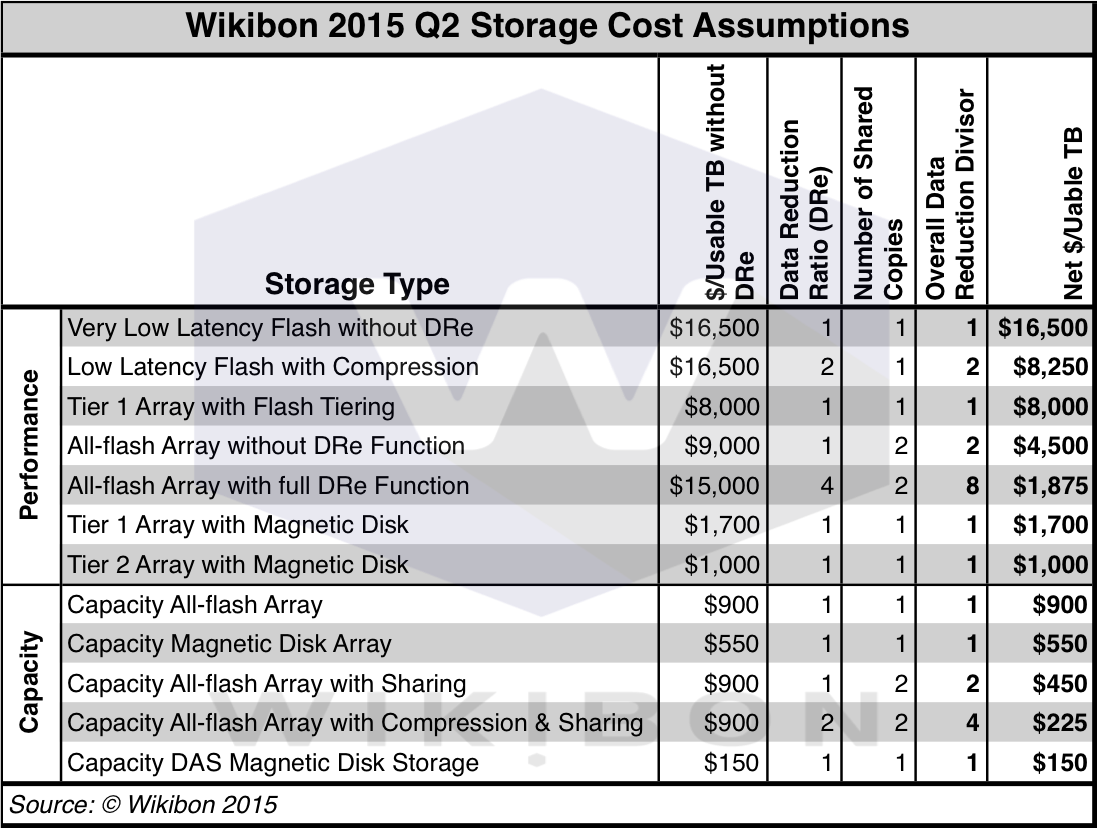
Flash storage continues on a trajectory to become more affordable than magnetic disk for the majority of IT applications by the end of 2016, according to Wikibon’s latest Storage Cost Assumptions.
In fact, flash has already surpassed magnetic disk as the most cost-effective medium for performance-driven applications, according to Wikibon CTO & Co-founder David Floyer. Although raw flash storage is still more expensive than disk, the cost savings from data reduction, de-duplication and sharing already make it cheaper than disk on a net cost per usable terabyte basis.
A standard high-performance all flash array costs up to $16,500 per usable terabyte out of the box, Wikibon estimates. However, with full data reduction and sharing enabled, the cost per usable terabyte drops to just $1,875. That compares to a cost of $8,000 per usual terabyte for a disk-based tier 1 array with flash tiering. “For performance disk, it’s no longer a race. Flash has won,” Floyer said.
Disk storage still enjoys a modest advantage in high-capacity scenarios such as archival storage and video serving, with prices as low as $150 per usable terabyte for direct-attached storage. However, flash is close to the crossover point, with a fully compressed and shared array coming in at $225 per usable terabyte. And when deployed as an array instead of attached directly to the processor, flash’s per-terabyte cost is less than half that of comparable magnetic disks.
That doesn’t even take into account other compelling benefits of flash, including dramatically faster access speed, longer usable life, lower power consumption and the ability to share the same physical storage in multiple virtual instances. Floyer said he is currently working with one user that has deployed 40 logical copies of a database in flash using only 5% of the space that would be required for a comparable disk-based deployment. In fact, such a shared-use scenario is almost impossible with disk because of the time required to replicate and synchronize copies of the database.
Flash prices are also falling faster than disk. “Wikibon expects NAND (negative-AND) flash prices to drop by 30 percent per year, and disk prices to drop by 20 percent per year,” the report says. “For installations that can organize to utilize data reduction and data sharing on flash, Wikibon expects that capacity flash will be lower cost than capacity disk in 2016.”
It’s taking time for the message to percolate through to IT buyers, though, who collectively spent about $30 billion on external disk storage systems in 2014, according to International Data Corp.
“Disks aren’t dead,” Floyer said. “There are always some situations where disks makes sense.” Those include encrypted storage and steaming video, where flash’s deduplication and sharing advantages aren’t material. However, the arguments for using disk are dwindling in the face of flash’s surging price/performance gains.
The full report on storage cost assumptions, which underlie much of Wikibon’s storage-related research, can be seen on Wikibon Premium.
… We’d like to tell you about our mission and how you can help us fulfill it. SiliconANGLE Media Inc.’s business model is based on the intrinsic value of the content, not advertising. Unlike many online publications, we don’t have a paywall or run banner advertising, because we want to keep our journalism open, without influence or the need to chase traffic.The journalism, reporting and commentary on SiliconANGLE — along with live, unscripted video from our Silicon Valley studio and globe-trotting video teams at theCUBE — take a lot of hard work, time and money. Keeping the quality high requires the support of sponsors who are aligned with our vision of ad-free journalism content.
If you like the reporting, video interviews and other ad-free content here, please take a moment to check out a sample of the video content supported by our sponsors, tweet your support, and keep coming back to SiliconANGLE.






