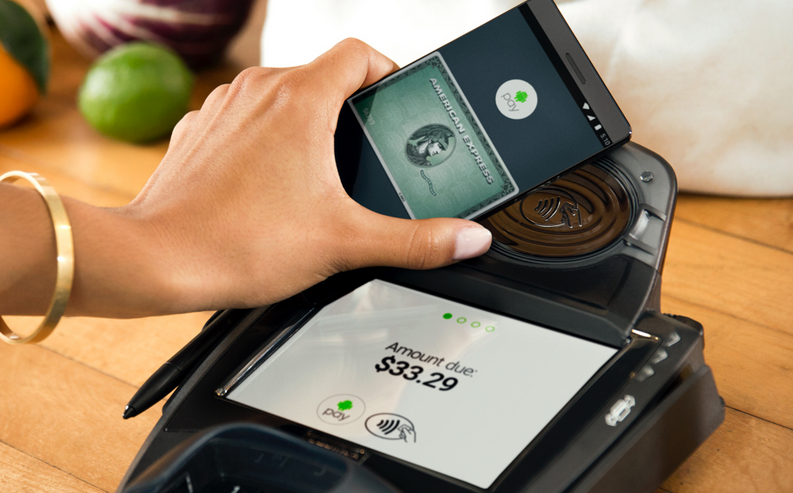







Google will have to explore other avenues to earn money from its recently announced mobile payments service, Android Pay. Unlike rival Apple Pay, Android Pay will not earn Google a percentage of each transaction processed via the payments service.
According to a report from The Wall Street Journal, this is “because Visa Inc. and MasterCard Inc., which operate the dominant payment networks, recently standardized their ‘tokenization’ card-security service and made it free, preventing payments services from charging fees to issuers.”
Tokenization, when applied to data security, says Wikipedia, is the process of substituting a sensitive data element with a non-sensitive equivalent, referred to as a token, which has no extrinsic or exploitable meaning or value.
In the case of mobile payments, tokenization replaces sensitive credit card details with a unique code – a token – that can only be used once. In this manner, credit card details are never transmitted or shared with merchants, adding an extra layer of security.
Apple negotiated three-year contracts with banks and credit card issuers under which it receives 0.15 percent on credit card transactions and 0.5 percent on all debit card transactions processed through Apple Pay. These contracts now have roughly two years remaining.
Anonymous bank executives told The Wall Street Journal that they were “unhappy” sharing fees with Apple. It appears that some banks may try renegotiating with Apple to lower – or eliminate – the share of mobile payments it receives. One such opportunity, notes the publication, may present itself as Apple finds itself negotiating terms for the international expansion of Apple Pay.
“This is a bold move on behalf of the banks,” Rick Oglesby, head of research at Double Diamond Payments Research told The Wall Street Journal. After agreeing to Apple’s terms for Apple Pay, “they’re now taking a stand against similar deals. It could easily turn into a standoff.”
Visa announced the changes to its tokenization service on May 28, the same day Google announced Android Pay at Google I/O.
People familiar with Google’s plans claim, “The new rules are a blow to Google, which had been negotiating with large banks to get the same deal as Apple.”
The same is likely to be true for Samsung Electronics Co. Ltd, which announced its mobile payments service, Samsung Pay – in partnership with Visa and MasterCard – in March. Samsung Pay is slated to launch in September.
Support our mission to keep content open and free by engaging with theCUBE community. Join theCUBE’s Alumni Trust Network, where technology leaders connect, share intelligence and create opportunities.
Founded by tech visionaries John Furrier and Dave Vellante, SiliconANGLE Media has built a dynamic ecosystem of industry-leading digital media brands that reach 15+ million elite tech professionals. Our new proprietary theCUBE AI Video Cloud is breaking ground in audience interaction, leveraging theCUBEai.com neural network to help technology companies make data-driven decisions and stay at the forefront of industry conversations.





