



 NEWS
NEWS
NEWS
NEWS
NEWS

Can Oracle, a late entrant in the cloud infrastructure market, really achieve its audacious goal of going to head-to-head with Amazon Web Services (AWS)? Many people think so.
In rolling out 24 new cloud services yesterday and committing itself to basically putting its entire product family online, Oracle pulled out the heavy weaponry. For example, its new Archive Storage will be aimed directly at Amazon’s Glacier service but will be priced 90% lower. “We’re prepared to compete with Amazon.com on price,” said founder Larry Ellison.
That could be a tricky proposition. As The Register’s Gavin Clarke points out, AWS has cut storage prices 48 times in eight years, successfully fending off price competition from Microsoft.
Oracle also brings advantages to the game that no other competitor can match, at least not at its scale. Its products span the full spectrum of infrastructure-as-a-service (IaaS), platform-as-a-service (PaaS) and software-as-a-service (SaaS). About the only area where Oracle doesn’t have a competitive offering is in networking, but neither do its cloud foes.
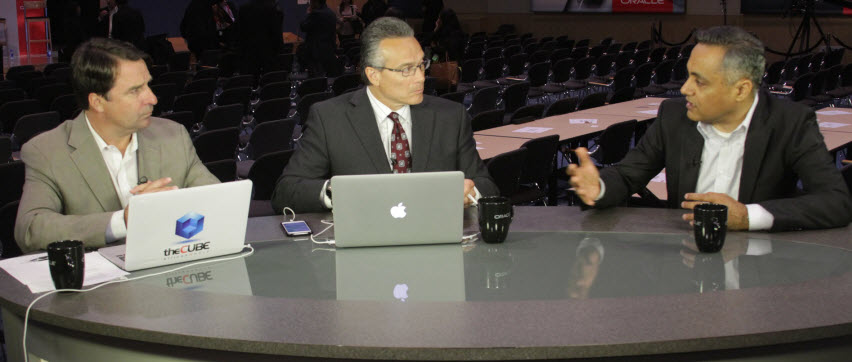
“They control everything from the iron right up to the top of the software stack,” said Carl Olofson, research vice president for application development and deployment at International Data Corp., in an interview on theCUBE (below).
“Oracle seems to have a clean product line: IaaS, PaaS and SaaS,” said Wikibon Co-Founder and Chief Analyst David Vellante. “It has differentiation.”
Oracle’s own PaaS is the platform that the company uses to build all its own applications. Customers will be able to use that same platform to extend those applications with complete compatibility, Oracle CEO Larry Ellison said during his keynote address. He claimed that on-premise provisioning and configuration that require 8½ hours on AWS take less than two hours in the Oracle cloud, with many fewer commands required.
Oracle also has an enormous base of customers that pay maintenance fees that throw off a lot of cash. The company also has considerably more leverage over customers that use its database and enterprise applications than it would if it were just a box-seller. “Oracle has a massive customer footprint. If they can roll those companies to the cloud it will be a strategic win for them,” said SiliconANGLE founder John Furrier.
Finally, Oracle understands the complex on-premise environments that most of its customers already have. In contrast to Amazon, which has largely ignored hybrid clouds, Oracle is promising to make the transition between public and private cloud as painless as possible, and enable customer to choose their own configuration.
Oracle intends to leverage that cross-platform expertise to keep customers in the fold. “The full stack working together is where we differentiate ourselves,” said Steve Daheb, senior vice president of PaaS, business intelligence and enterprise performance management business groups at Oracle in an interview on theCUBE (below).
“Writing your own systems to communicate with the database and the cloud is awkward. It works much better when you have everything on the same cloud platform,” said IDC’s Olofson.
Few companies are also as effective at Oracle at leveraging an existing customer base. “We think that the maturity of the product offering is enabling the company to focus much more on the cross-sell and upsell opportunity that comes with this large base of enterprise customers, and these results have started to show through in the top line growth of the cloud business,” wrote Barclays analysts Raimo Lenschow and Harris Heyer in a research brief.
The bottom line is that Oracle may be one of the few companies that doesn’t have to shrink before it grows, Vallente said. The question is whether new growth can offset the headwinds of change from a shrinking business model.
IDC’s Olofson said he thinks it can. “When you move from a perpetual use of model to a subscription model, there’s going to be a short-term hit,” he said, “but over time it works out to be a more stable business because you have an ongoing revenue stream.”
That’s what Oracle is betting on. Writing on Forbes.com, Oracle’s Chris Murphy deconstructs the cloud subscription model and says it’s not only more predictable but also more profitable. ““It’s about the same as license and support,” Ellison says in a quote in the article. “It’s stunningly profitable.”
… We’d like to tell you about our mission and how you can help us fulfill it. SiliconANGLE Media Inc.’s business model is based on the intrinsic value of the content, not advertising. Unlike many online publications, we don’t have a paywall or run banner advertising, because we want to keep our journalism open, without influence or the need to chase traffic.The journalism, reporting and commentary on SiliconANGLE — along with live, unscripted video from our Silicon Valley studio and globe-trotting video teams at theCUBE — take a lot of hard work, time and money. Keeping the quality high requires the support of sponsors who are aligned with our vision of ad-free journalism content.
If you like the reporting, video interviews and other ad-free content here, please take a moment to check out a sample of the video content supported by our sponsors, tweet your support, and keep coming back to SiliconANGLE.






