



 NEWS
NEWS
NEWS
NEWS
NEWS

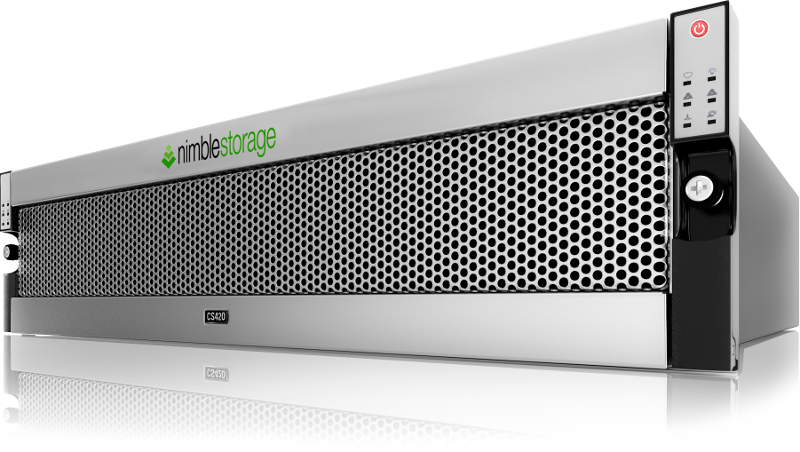
Having recently witnessed two of its top rivals roll out new capabilities for their respective flash arrays only a few weeks apart, Nimble Storage Inc. is now joining the fray as well with a landmark update of its own. Making up for its late entry is a slew of major new features that will help make its systems much more competitive in the enterprise.
The arguably biggest addition introduced in the new release of its Adaptive Flash stack is a tiering function that provides administrators with the option of running a workload solely on the solid-state drives in their arrays. That is invaluable for high-priority applications such as databases that need the best possible response times an organization can provide.
Nimble says that customers can also take advantage of the feature to support dynamic services that only require the superior performance of flash some of the time. Something like, say, a virtual desktop environment could be moved onto SSDs during the morning log-in rush and bumped back down to its normal service level once the boot storm has subsided.
That makes Nimble’s hybrid systems a potentially very viable alternative to the much most expensive pure-flash arrays from its numerous competitors, a pitch made even more attractive by an upgrade to its cloud-connected monitoring service made in conjunction. The performance dashboard now provides visibility into how operational changes such as switching service levels impact individual virtual machines.
The increased granularity levels the playing against Tegile Systems Inc. and Tintri Inc., two of the all-flash vendors competing with Nimble, which have been offering VM-level monitoring for quite some time now. The company is not stopping at that, however. Complementing the improved visibility is a set of APIs that make it possible to pull data from the service into reporting tools that can be used to turn the raw metrics into easily-presentable dashboards and visualizations.
Rounding out the update is a native security function that introduces native encryption and, no less importantly, the ability to permanently wipe files from a system. SmartSecure, as the feature is called, works both at the array- and application-level to let customers be selective in which files they scramble or delete. It removes the need to use third party privacy tools, thus eliminating a potentially significant expense while removing the associated management overhead for users.
… We’d like to tell you about our mission and how you can help us fulfill it. SiliconANGLE Media Inc.’s business model is based on the intrinsic value of the content, not advertising. Unlike many online publications, we don’t have a paywall or run banner advertising, because we want to keep our journalism open, without influence or the need to chase traffic.The journalism, reporting and commentary on SiliconANGLE — along with live, unscripted video from our Silicon Valley studio and globe-trotting video teams at theCUBE — take a lot of hard work, time and money. Keeping the quality high requires the support of sponsors who are aligned with our vision of ad-free journalism content.
If you like the reporting, video interviews and other ad-free content here, please take a moment to check out a sample of the video content supported by our sponsors, tweet your support, and keep coming back to SiliconANGLE.






