 WIKIBON
WIKIBON
WIKIBON






WIKIBON

“The growth rate of Docker has gone beyond ludicrous; it’s now plaid,” said Battery Ventures VC Adrian Cockcroft on theCUBE (see embedded video below). And the evolution of container technology has accelerated to the point that new versions are coming out every two to three months, writes Wikibon Senior Analyst Stu Miniman.
In his latest Wikibon Alert, Miniman updates his report “Time for the Enterprise Container Conversion,” written just three months earlier, and discusses the most significant of a list of announcements from Docker, Inc. and other container companies since then.
The growth in containers was dramatized at both DockerCon 2015 and the recent Red Hat Summit. DockerCon attendance of 2,000-2,500 people represented a nearly five-fold growth from 2014. Enterprise vendors including IBM, Microsoft, EMC, VMware, Inc., Cisco Systems, Inc., Hewlett-Packard Co. and Amazon Web Services had major presences at both events as they worked to align their portfolios to container technology.
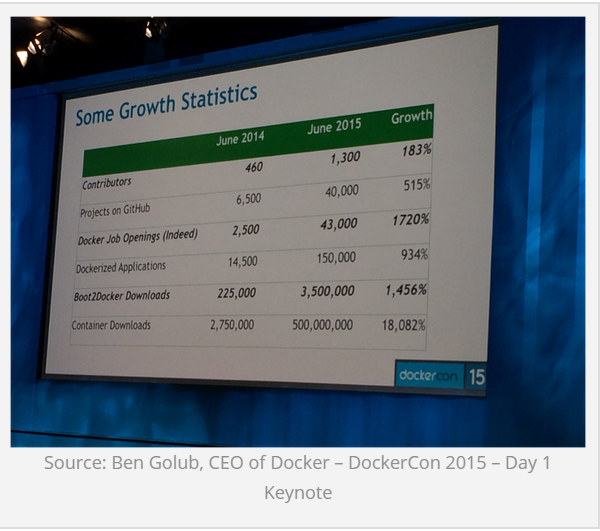
Docker CEO Ben Golub said Docker downloads grew from three million in 2014 to more than 500 million so far in 2015. The question, Miniman writes, is how many paying customers will come from all these downloads? Is this the start of broad market adoption, or is Docker the infrastructure equivalent of the “freemium” model in which one to five percent of customers ultimately pay?
At DockerCon several blue-chipd customers – including the General Services Administration with and Booz Allen, Business Insider, Capital One Financial Corp., General Electric Co., GrubHub, Inc., The New York Times Co., Orbitz Worldwide, Inc. and PayPal Holdings, Inc. – were featured. Whether this indicates the start of broad enterprise adoption of Docker and other container technologies such as AWS Kubernetes and CoreOS, Inc.’s rkt (pronounced “rocket”) remains to be seen, however.
Containers have strong advantages over virtual machines, but also gaps, Miniman writes. The ecosystem is highly fragmented right now, and tools to federate different container services are still emerging. One major development is the new runC standard that provides portability between different container versions from different companies. Another is robust support of software-defined networking (SDN) from Docker in the form of “Docker Networking,” the integration of Socketplane into Docker’s containers, announced at DockerCon.
Miniman also discusses the importance of data persistence and plugins, both of which were featured subjects at the two conferences. He examines the progress on adding security to Docker’s container technology and support for container portability across Hybrid Clouds including between Linux and Microsoft Windows.
All of this activity, he says, indicates that containers are the latest disruptive technology impacting information technology. “The time is NOW to begin exploring the technology,” he concludes.
Miniman’s full report is available on the Wikibon Premium Web site.
Support our mission to keep content open and free by engaging with theCUBE community. Join theCUBE’s Alumni Trust Network, where technology leaders connect, share intelligence and create opportunities.
Founded by tech visionaries John Furrier and Dave Vellante, SiliconANGLE Media has built a dynamic ecosystem of industry-leading digital media brands that reach 15+ million elite tech professionals. Our new proprietary theCUBE AI Video Cloud is breaking ground in audience interaction, leveraging theCUBEai.com neural network to help technology companies make data-driven decisions and stay at the forefront of industry conversations.





