







The last few years have seen an explosion in the independent developer scene that has shaken up the video game industry, with thousands of new studios popping up that range from one-man operations to multi-million dollar companies. After a handful of outlier success stories like DayZ and Minecraft, thousands of game makers are setting out on their own, either to create the next big thing or simply to fill a niche that is underserved by AAA titles.
These days there seem to be more indie games than ever, and there has started to be a growing concern that the bubble could soon pop in a so-called “indiepocalypse,” leading to a collapse of the indie market.
But developer Ryan Clark, a game maker with more than 10 years of experience as an independent developer, says that the indiepocalypse is a myth, and things do not look nearly so bleak.
According to Clark, the indiepocalypse theory focuses on five ideas:
“I contend that the ‘indiepocalypse’ is a myth,” Clark said in a recent blog post, “and that these 5 ideas are misleading in subtle ways.”
In regards to the “too much competition” idea, Clark explained that contrary to some developers’ beliefs, programs like Steam Greenlight are not a bad thing.
“You need to make a noteworthy game that sells well in order to succeed on Steam. This was true before Greenlight, and it is still true now,” Clark said. “The only difference is that the playing field is now a fairer one.”
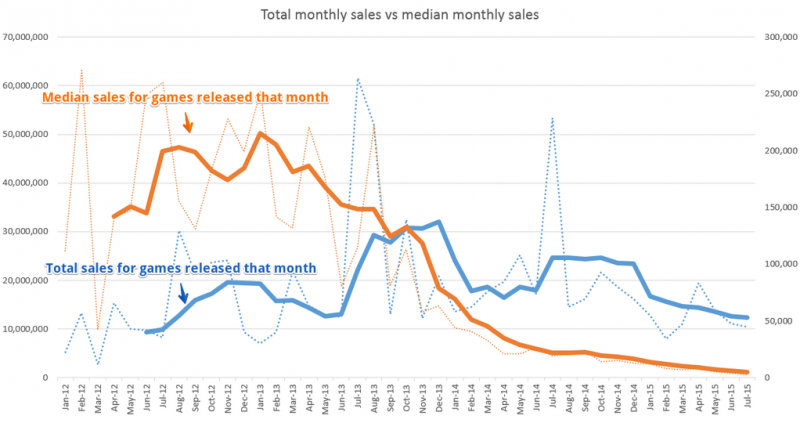
Clark also notes that the analytics many people point to showing a drastic increase in the number of indie games or a decline in the overall profitability of indie games are misleading because they overlook too many variables. He points out that many of those new games are shovelware that are being dumped onto Steam “because it’s easy to do,” and while one chart may show that median indie revenue is down, that is only because of those throwaway games that no one plays.
“Charts like these are interesting and helpful,” Clark said. “It’s always better to have more information! But make sure you think about what they are really representing, and what outside factors may also have had an impact, before you draw any conclusions.”
One of the most common fears regarding indie games on Steam is that the marketplace will become like the App Store, which is overrun with cheap, generally poor quality games.
“The perceived problems with the App Store are its visibility issues, low pricing, poor quality games, and hit driven nature,” Clark said. “Why isn’t Steam like that? (Well, it is in some respects, but not to remotely the same degree.) I think it’s because of the audience.”
He added, “Mobile games are (typically) smaller and have shorter dev times, so there is less pre-launch hype. Additionally, I don’t think that your average mobile gamer spends as much time on gaming websites, blogs, twitter feeds, streams, etc, as a Steam or console gamer. So how do mobile gamers find out about new mobile games? Via word of mouth, or on the App Store itself. This magnifies the hit driven nature of the App Store.”
Clark explained that Steam users are more aware of upcoming games in general because they seek that information out, which is a stark contrast to the mobile marketplace which essentially has to shout and carry around a flashing sign to get noticed.
Another doomsday sign Clark refutes is the lukewarm reception toward several high-profile games. He explains that while there may be more disappointing high-profile indie games, that is only because there are more high-profile indie games in general.
“It is only natural that some of those games will not achieve the same spectacular sales results as their predecessors,” Clark said. “If these games had been launched by unknown developers, the press and twittersphere would not have paid attention to the launch numbers. No fear would have been generated.”
Perhaps one of the most common fears for many new indie devs is the pressure to compete with “triple-I” games, the high budget indie titles that rival AAA games in funding and exposure. With games like Star Citizen receiving tens of millions of dollars from crowdfunding, many game makers fear that the budget needed to make a “good” indie game could inflate out of their reach, but Clark says they have nothing to worry about.
“Some of the biggest indie hits in recent memory were made by relatively small teams,” Clark said. “Look at Risk of Rain, Banished, FTL, Democracy 3, Papers Please, Rogue Legacy, etc. … Indies don’t need to be bleeding edge like AAA. The forces that pushed budgets up in the AAA space do not exist in the indie space.”
Support our mission to keep content open and free by engaging with theCUBE community. Join theCUBE’s Alumni Trust Network, where technology leaders connect, share intelligence and create opportunities.
Founded by tech visionaries John Furrier and Dave Vellante, SiliconANGLE Media has built a dynamic ecosystem of industry-leading digital media brands that reach 15+ million elite tech professionals. Our new proprietary theCUBE AI Video Cloud is breaking ground in audience interaction, leveraging theCUBEai.com neural network to help technology companies make data-driven decisions and stay at the forefront of industry conversations.





