



 NEWS
NEWS
NEWS
NEWS
NEWS

Apple’s reputation of providing platforms that are impervious, or close thereto, to malicious attacks has taken another slight battering with an exploit found in its OS X operating system that allows for the installation of malicious code.
The newly discovered exploit takes advantage of a flaw in OS X’s “Gatekeeper” feature, which verifies that software being installed on an Apple Mac is safe to do so.
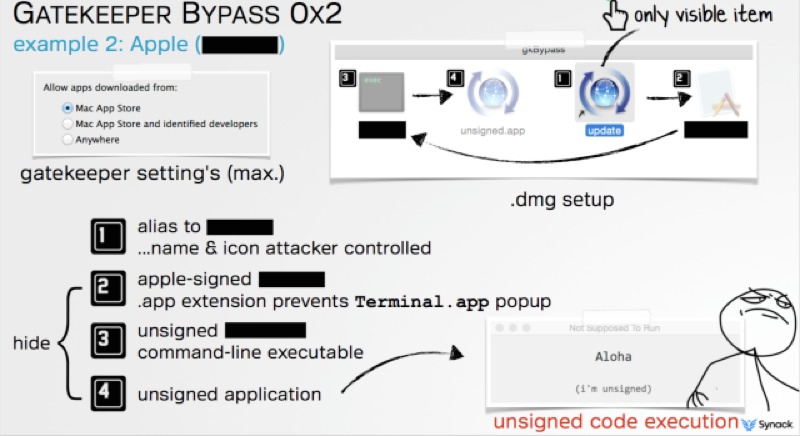
Patrick Wardle, Director of Research of security firm Synack, Inc. discovered the exploit, which as he explained to Ars Technica uses a binary file already trusted by Apple to pass through Gatekeeper; once the trusted file passes through the Gatekeeper security check it is said to execute one or more malicious files that can install a variety of programs including password loggers, botnet software, and other forms of nefarious things.
“It’s not super complicated, but it effectively completely bypasses Gatekeeper,” Wardle explained. “This provides hackers the ability to go back to their old tricks of infecting users via Trojans, rogue AV scams or infect applications on Pirate Bay.”
Noting that the risks are more than the occasional stray user, Wardle added that “more worrisome to me is this would allow more sophisticated adversaries to have network access…Nation states with higher level access, they see insecure downloads, they can swap in this legitimate Apple binary and this malicious binary as well and man-in-the-middle the attack and Gatekeeper won’t protect users from it anymore.”
Implementing the exploit is simply a matter of changing the name of one binary file to another:
[The] exploit works by renaming Binary A but otherwise making no other changes to it. He then packages it inside an Apple disk image. Because the renamed Binary A is a known file signed by Apple, it will immediately be approved by Gatekeeper and be executed by OS X.
From there, Binary A will look for Binary B located in the same folder, which in this case is the downloaded disk image. Since Gatekeeper checks only the original file an end user clicks on, Wardle’s exploit swaps out the legitimate Binary B with a malicious one and bundles it in the same disk image under the same file name. Binary B needs no digital certificate to run, so it can install anything the attacker wants.
Wardle claims to have informed Apple of the vulnerability 60 days ago with the tech giant yet to issue a patch for it, although it is believed a patch is currently being worked; it could be some time off, as the patch is said to require a number of serious changes to the OS X code base.
The vulnerability is believed to apply to all versions of OS X since 2012 which use Gatekeeper to verify installs.
… We’d like to tell you about our mission and how you can help us fulfill it. SiliconANGLE Media Inc.’s business model is based on the intrinsic value of the content, not advertising. Unlike many online publications, we don’t have a paywall or run banner advertising, because we want to keep our journalism open, without influence or the need to chase traffic.The journalism, reporting and commentary on SiliconANGLE — along with live, unscripted video from our Silicon Valley studio and globe-trotting video teams at theCUBE — take a lot of hard work, time and money. Keeping the quality high requires the support of sponsors who are aligned with our vision of ad-free journalism content.
If you like the reporting, video interviews and other ad-free content here, please take a moment to check out a sample of the video content supported by our sponsors, tweet your support, and keep coming back to SiliconANGLE.






