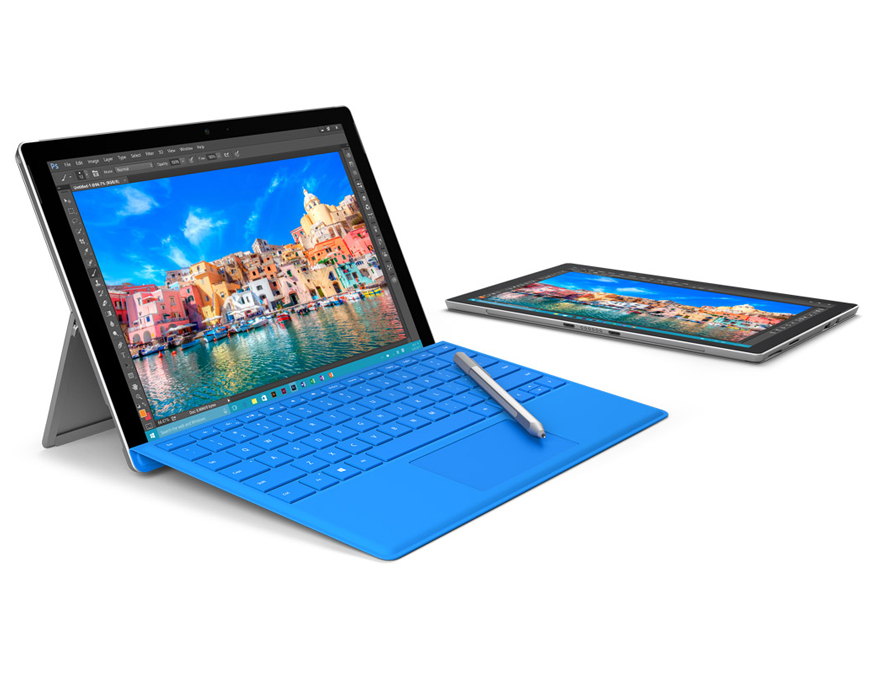







Microsoft yesterday took the wraps off the next generation Surface Pro, the tablet that can replace your laptop. The Surface Pro 4 is thinner, lighter and faster than its predecessor, the Surface Pro 3, and boasts a larger screen, is powered by sixth-generation (Skylake) Intel processors and has up to 1 terabyte of storage space.
Microsoft’s Surface Pro 3 mainly faced competition from Apple’s MacBook Air in the lightweight, ultra-portable laptop space but, thanks to the arrival of new two-in-one tablets like the iPad Pro and Google’s Pixel C, the Surface Pro 4 has a few new competitors to contend with.
Apple’s 12.9-inch iPad Pro is the biggest iPad to date and also the first to include an Apple-designed keyboard and stylus (Apple Pencil). Thanks to new multitasking features in iOS 9 and a number of third-party apps – including Microsoft’s Office Suite for iOS – adding functionality for the Apple Pencil, the iPad Pro promises to be a versatile and productivity-focused tablet that could stand-in for your laptop.
Also joining the hybrid party is Google’s 10.2-inch Pixel C tablet running on Android 6.0 Marshmallow with a cleverly designed optional full-size keyboard.
Before we take a look at what makes the Surface Pro 4 different from the iPad Pro and Pixel C, let’s see how they stack up in the technical specifications department.
|
Microsoft Surface Pro 4 |
Apple iPad Pro |
Google Pixel C |
|
| Operating system |
Windows 10 Pro |
iOS 9 |
Android 6.0 Marshmallow |
| Display |
12.3-inch PixelTouch |
12.9-inch Retina |
10.2-inch |
| Resolution |
2736 x 1824 at 267 ppi |
2732 x 2048 at 264 ppi |
2560 x 1800 at 308 ppi |
| Processor |
6th Gen Intel Core m3, i5, or i7, Intel Iris 540 |
64-bit A9X, M9 motion coprocessor |
Nvidia X1 quad-core, Maxwell GPU |
| RAM |
4GB, 8GB, or 16GB |
4GB |
3GB |
| Storage |
Up to 1TB |
32GB, 128GB |
32GB, 64GB |
| Ports |
Full-size USB 3.0, microSD card reader, Headset jack, Mini DisplayPort, Cover port. SurfaceConnect |
Lightning, Smart Connector for keyboard |
USB Type-C, Headset jack |
| Front Camera |
5.0-megapixel |
1.2-megapixel |
TBD |
| Rear Camera |
8-megapixel |
8-megapixel |
TBD |
| Battery |
Up to 9 hours video playback |
Up to 10 hours video playback |
Up to 10 hours |
| Dimensions (Inches) |
11.5 x 7.9 x 0.33 |
8.68 x 12 x 0.27 |
TBD |
| Weight (Pounds) |
1.73 |
1.57 |
TBD |
| Base price |
$899 |
$799 |
$499 |
| Stylus/Keyboard |
Surface Pro 4 Type Cover ($129.99), Surface Pen included |
Optional keyboard ($169) and Apple Pencil ($99) |
Optional Bluetooth wireless keyboard ($149), No stylus |
This is perhaps the single biggest differentiator between true two-in-one tablets and larger-screen tablets that also happen to come with a keyboard.
The Surface Pro 4 runs a full version of Windows 10 Pro and, as a result, is able to run any software program and perform any task users would expect from a traditional laptop or desktop experience. Add to that the additional functions and features made possible by the Surface Pen, and you have a productivity powerhouse.
The iPad Pro goes a long way to bridge the gap between tablet and laptop thanks to multitasking features in iOS 9 like Split View, Slide Over and Picture in Picture along with adding a slew of new applications and features for use with the Apple Pencil. The downside is that the iPad Pro cannot run the same range of software as a laptop and has to make do with app versions of popular productivity apps like Microsoft Office and others that often lack a full set of features.
Google’s Pixel C, albeit with some multitasking features in Android 6.0 Marshmallow, suffers the same shortcomings as the iPad Pro.
The Surface Pro 4 is available with up to 1TB of storage while the iPad Pro is limited to 128GB and the Pixel C tops out at 64GB. Granted, 128GB is plenty, but with the Surface Pro 4 you are less likely to ever worry about running out of space.
As for connecting peripherals to your tablet, the Surface Pro 4 offers a full-size USB 3.0 port, microSD card reader, and a Mini DisplayPort, giving you ample room to connect a mouse, second display, or transfer files to and from your device.
The iPad Pro and Pixel C are limited to a Lightning connector and USB Type-C port respectively, significantly limiting the ability to connect most peripherals to your tablet.
The Surface Pro 4 is available for pre-order now and shipping starts October 26th. The iPad Pro goes on sale sometime in November and the Pixel C should hit the market in time for Christmas shopping.
Support our mission to keep content open and free by engaging with theCUBE community. Join theCUBE’s Alumni Trust Network, where technology leaders connect, share intelligence and create opportunities.
Founded by tech visionaries John Furrier and Dave Vellante, SiliconANGLE Media has built a dynamic ecosystem of industry-leading digital media brands that reach 15+ million elite tech professionals. Our new proprietary theCUBE AI Video Cloud is breaking ground in audience interaction, leveraging theCUBEai.com neural network to help technology companies make data-driven decisions and stay at the forefront of industry conversations.





