



 NEWS
NEWS
NEWS
NEWS
NEWS

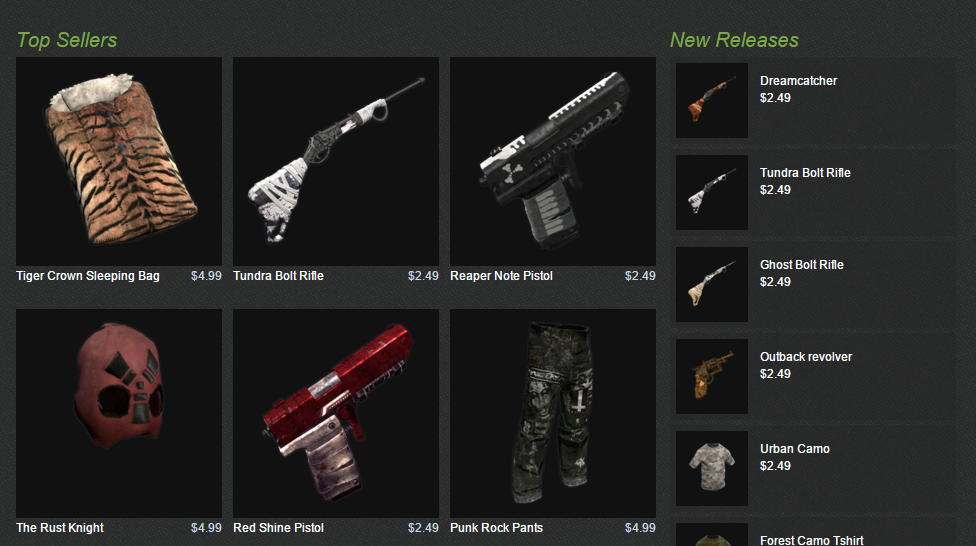
Team Fortress 2 is probably one of the best examples of a successfully monetized free-to-play game, and Valve Corp. has now made it easier for other studios to copy its formula by introducing a new Item Store feature for developers on Steam. The Item Store is already being used by Early Access survival game Rust, which is now selling dozens of cosmetic items.
“This new Item Store is designed to make it easy for developers to establish an in-game economy or to just sell individual cosmetic items, keys, or consumables,” Valve said in a post on the Steam Dev Community Group (via Eurogamer). “And, it’s designed to easily integrate with a curated Workshop (similar to Team Fortress 2) so you can accept user-made items, use that data to create item definitions and prices in the Steam Inventory Service, and set those items for sale via the Item Store.”
“Steam takes care of the checkout process, splitting payments to Workshop authors as appropriate, and adding the items to users’ inventories. Your game then just needs to be able to call the Workshop to download item content in the right circumstances for your game,” Valve continued.
While some developers may be excited about the new Item Store feature, it has some users worried about what sorts of items will be sold, especially after the recent Payday 2 fiasco, whose developer added paid items that offer distinct in-game advantages.
Of course, as Payday 2 demonstrated, developers do not really need Valve’s help coming up with pay-to-win schemes, even if the new Item Store feature would make them easier to implement.
The new Item Store is not the first time Valve has offered developers a feature that was first pioneered (or at least perfected) by Team Fortress 2. In February, Valve launched an inventory tool that makes it easier for developers to reward players with in-game items when they complete certain actions or achievements.
… We’d like to tell you about our mission and how you can help us fulfill it. SiliconANGLE Media Inc.’s business model is based on the intrinsic value of the content, not advertising. Unlike many online publications, we don’t have a paywall or run banner advertising, because we want to keep our journalism open, without influence or the need to chase traffic.The journalism, reporting and commentary on SiliconANGLE — along with live, unscripted video from our Silicon Valley studio and globe-trotting video teams at theCUBE — take a lot of hard work, time and money. Keeping the quality high requires the support of sponsors who are aligned with our vision of ad-free journalism content.
If you like the reporting, video interviews and other ad-free content here, please take a moment to check out a sample of the video content supported by our sponsors, tweet your support, and keep coming back to SiliconANGLE.






