



 NEWS
NEWS
NEWS
NEWS
NEWS

In a three-way partnership Microsoft Corp., Mojang AB and Code.org have announced the celebration of the third annual Hour of Code, a programming event directed at teaching children to program computers, with the introduction of Minecraft as a coding environment.
Launched in 2013, Code.org is a non-profit with the mission of increasing participation of women and underrepresented students of color in the STEM field of computer science. The organization does this by providing a broad variety of programs and resources for students that are easily accessible and provide powerful learning environments.
In the vein of Code.org’s vision, Mojang’s extremely popular game Minecraft provides an excellent backdrop for educating anyone in programming. In 2014, Minecraft exceeded 100 million registered players and has continued a stellar rise in popularity since. The game’s ease of access and attractiveness to younger children makes it ideal for visual teaching. Minecraft’s developer, Mojang AB, was acquired by Microsoft for $2.5 million in the same year.
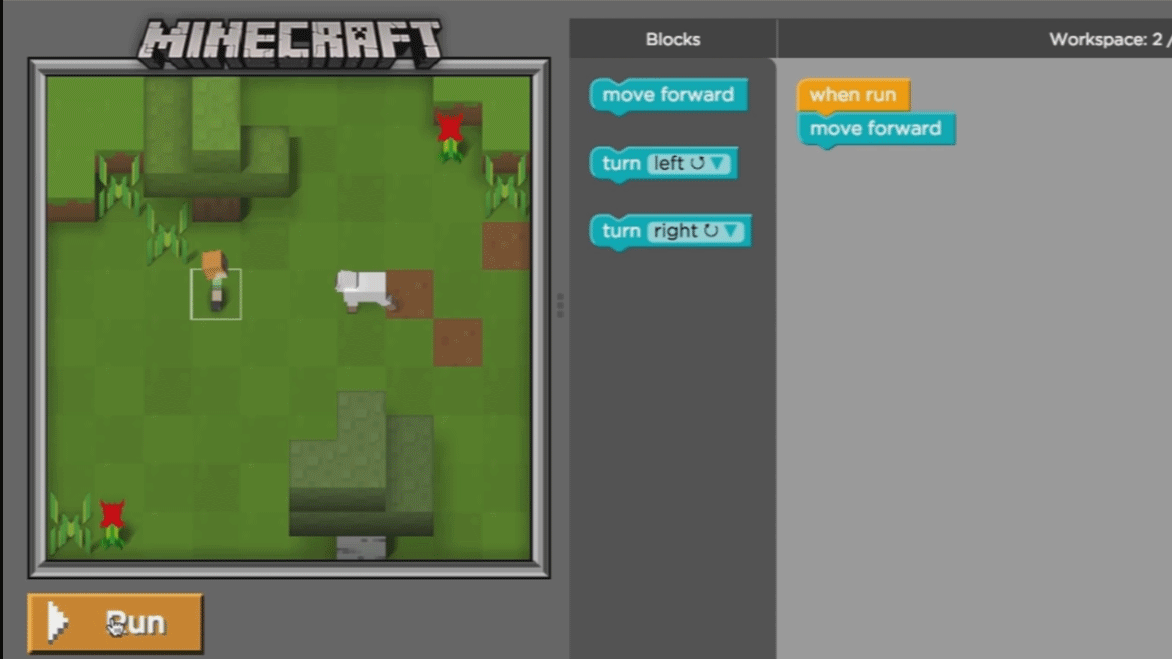
The new tutorial (described below) is available at https://code.org/mc–the campaign is expected to exceed 10,000 events during Computer Science Education Week, Dec. 7–13.
“A core part of our mission to empower every person on the planet is equipping youth with computational thinking and problem-solving skills to succeed in an increasingly digital world,” said Satya Nadella, chief executive officer, Microsoft. “With ‘Minecraft’ and Code.org, we aim to spark creativity in the next generation of innovators in a way that is natural, collaborative and fun.”
The Hour of Code Minecraft program is designed for ages 6 and up using a Minecraft tutorial that teaches basic coding skills. It does so by providing a visual interface where students “drag and drop” specific programming functions and commands into a command stack. All the while, the visual coding experience reminds students that it behind the scenes it is designing code similar to how code is normally developed.
Players are offered a set of 14 challenges, including free play time, to explore concepts they learn from the tutorial.
To many new developers programming languages may appear daunting because the tools used to create them do not look like the end product. Even with the first development of programming languages visual coding has been a mainstay of aiding new and young programmers in learning to code, one such educational language was Logo, developed in 1967, which used a turtle as a visual indicator. Coders could write simple programs (in a near-English language) that would propel the turtle across the screen.
In the case of the Hour of Code tutorial, Minecraft’s Steve and Alex become similar to Logo’s turtle. They follow a stack of code blocks, which represent common programming functions (e.g. statements, if-decisions, loops, etc.) and act according to that programming. The immediate, visual feedback from the Minecraft tutorial gives a more direct understanding of basic coding principles.
Visit Code.org for a large variety of educational resources for educators and students who want to be involved in computer science.
… We’d like to tell you about our mission and how you can help us fulfill it. SiliconANGLE Media Inc.’s business model is based on the intrinsic value of the content, not advertising. Unlike many online publications, we don’t have a paywall or run banner advertising, because we want to keep our journalism open, without influence or the need to chase traffic.The journalism, reporting and commentary on SiliconANGLE — along with live, unscripted video from our Silicon Valley studio and globe-trotting video teams at theCUBE — take a lot of hard work, time and money. Keeping the quality high requires the support of sponsors who are aligned with our vision of ad-free journalism content.
If you like the reporting, video interviews and other ad-free content here, please take a moment to check out a sample of the video content supported by our sponsors, tweet your support, and keep coming back to SiliconANGLE.






