







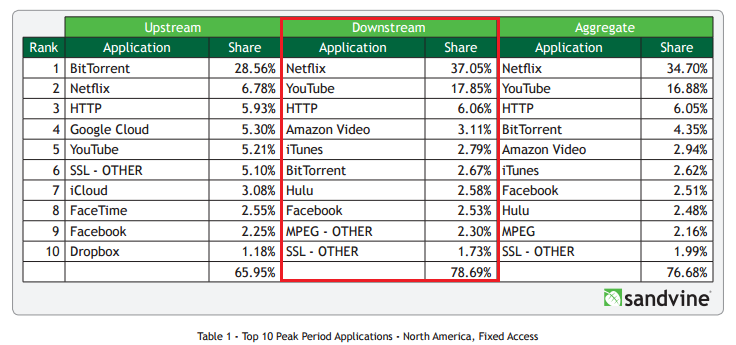
In case you weren’t sure how much time you spend streaming video and music, the latest Global Internet Phenomena Report (via Re/code) from networking company Sandvine Inc. indicates that real-time entertainment – that’s audio and video traffic – now accounts for over 70 percent of downstream bytes during peak periods of fixed-access broadband (home broadband) use in North America.
Netflix continued to dominate in the region, commanding 37.1 percent of downstream traffic during September and October 2015 – the period during which the study was conducted. This marks a small increase from the 36.5 percent share of traffic Netflix accounted for in Sandvine’s April report.
Netflix is not the only streaming content provider that got a bigger slice of the (growing) pie. Other real-time entertainment providers, such as YouTube, Amazon Video and Hulu have all seen a rise in traffic as a result of the growing market.
YouTube was again the second biggest traffic generator with a share of 17.85 percent, up from 15.5 percent in April.
Amazon, although still only accounting for a fraction of overall traffic, saw its share increase form 2 percent to over 3 percent to claim the number four spot while Hulu’s traffic increased from 1.9 percent to 2.6 percent.
As real-time entertainment continues to account for a larger share of broadband traffic, peer-to-peer file sharing via the BitTorrent protocol continues to see a decrease in bandwidth usage; now only accounting for 4.4 percent of peak-time downstream bytes, and only 5 percent of total volume during any 24 hour period. This is a significant decline from the 31 percent of bandwidth Sandvine found BitTorrent commanded in 2008.
It’s not just on fixed-access broadband where real-time entertainment steals the show. During peak period, streaming video and music also accounted for more than 40 percent of the downstream bytes on mobile broadband. According to Sandvine’s latest report, YouTube accounted for 20.8 percent of traffic, up from 19.8 percent a year ago.
Social media remained popular on mobile with Facebook taking the number two spot with a 16 percent share of traffic although it must be noted that this represents a decline from the 19.1 percent the social media giant commanded last year.
As for third-party messaging services, Snapchat continued its reign as the dominant player by commanding more mobile broadband traffic than competitive offerings such as WhatsApp. It appears (Snap) chatting is more popular on mobile than video or music streaming with Snapchat, the sixth largest by traffic, beating both Netflix and Pandora in traffic volume.
Update: An earlier version of this report incorrectly stated that BitTorrent traffic has declined. It has been corrected to reflect that, instead, BitTorrent’s percentage share of bandwidth has decreased.
Support our mission to keep content open and free by engaging with theCUBE community. Join theCUBE’s Alumni Trust Network, where technology leaders connect, share intelligence and create opportunities.
Founded by tech visionaries John Furrier and Dave Vellante, SiliconANGLE Media has built a dynamic ecosystem of industry-leading digital media brands that reach 15+ million elite tech professionals. Our new proprietary theCUBE AI Video Cloud is breaking ground in audience interaction, leveraging theCUBEai.com neural network to help technology companies make data-driven decisions and stay at the forefront of industry conversations.





