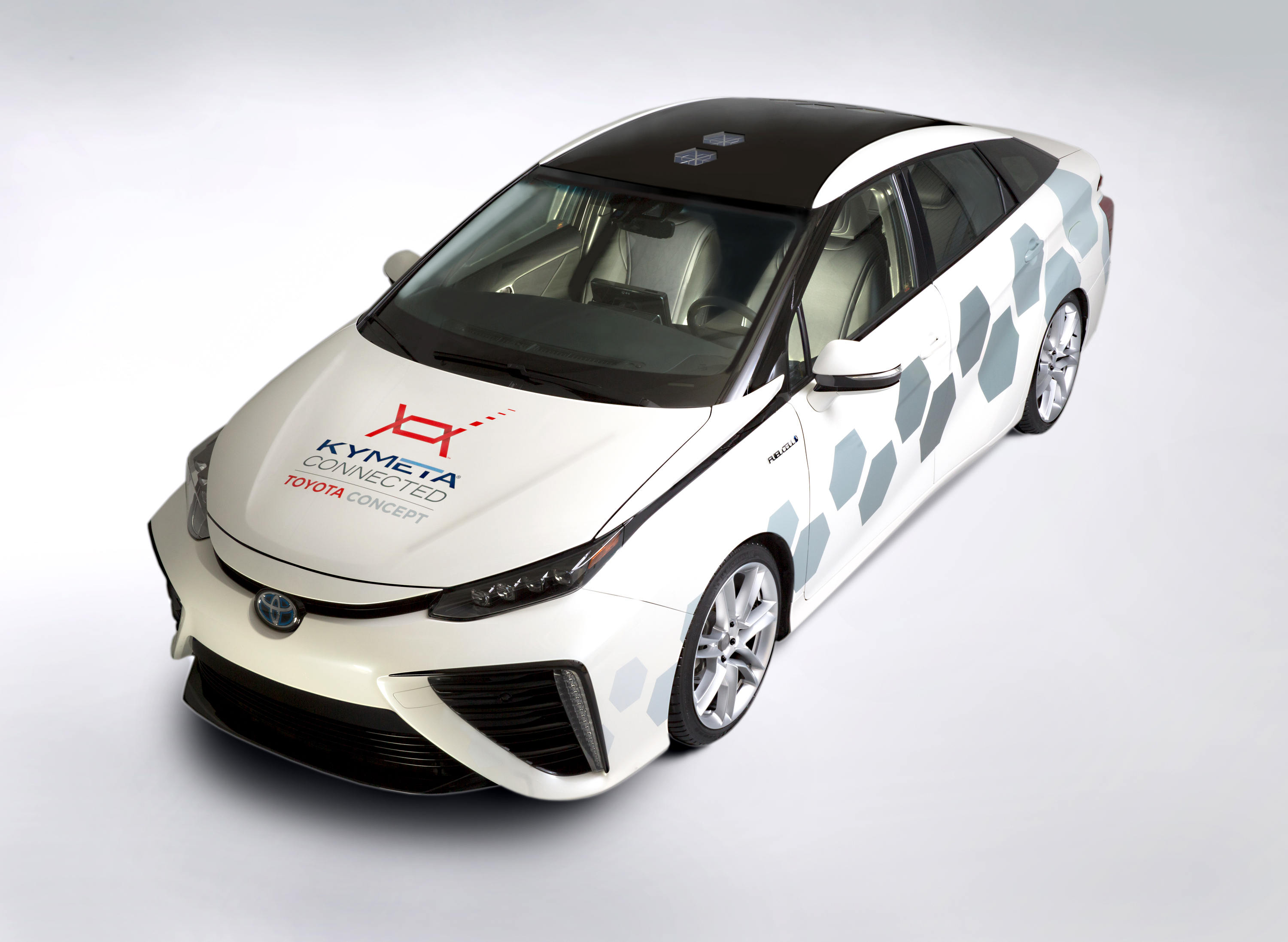







At the 2016 North American International Auto Show, currently underway in Detroit, Toyota Motor Corp. is showing off a hydrogen-powered Mirai research vehicle fitted with flat-panel antenna technology capable of high-speed, high-volume data connections via satellites.
The flat-panel antenna comes from Redmond, Wash.-based Kymeta Corp., a Bill Gates-backed startup, with which Toyota has formed an exclusive partnership to develop and test the on-car antenna.
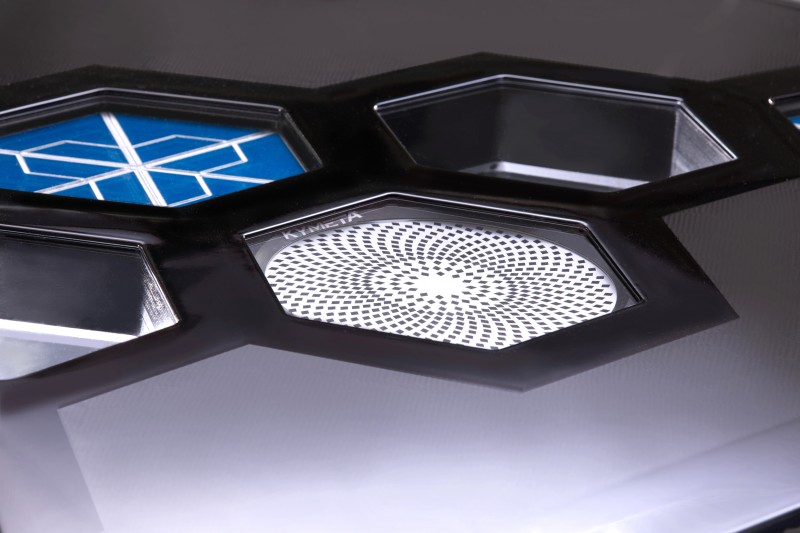
Instead of using a “dish” antenna – as is traditionally required for satellite communications – Kymeta’s flat-panel antenna has no mechanical components and uses software and liquid crystal technologies to electronically track and orient itself towards satellites.
No dish and no moving parts mean a lighter, more streamlined antenna that can be installed during vehicle assembly or as an aftermarket add-on without detracting from the vehicle’s design or hindering aerodynamics.
“For several years, Toyota met with emerging companies around the world to investigate new technologies,” said Shigeki Tomoyama, Senior Managing Officer of Toyota. “We were very excited to learn about Kymeta, because their flat antennae technology could solve the challenge of vehicle-based satellite communications.”
Satellite communications bring a number of benefits to evolving automotive connectivity needs, says Toyota, including the ability to distribute large amounts of data to a vehicle such as over-the-air software updates, infotainment content and vehicle-to-vehicle communication; larger coverage areas not limited by national borders; and more stable and secure communications, especially in emergencies such as natural disasters.
Kymeta has already clocked-up more than 8,000 miles of road testing with cars connected to satellites and claims its flat-panel antenna can download as much as one terabyte of data per month – roughly 100 times the data available on a typical monthly cellular plan.
In addition to leaving no poor coverage areas, a satellite connection is more secure than its cellular counterpart, said Kymeta Founder Dr. Nathan Kundtz, as it has a hundred million fewer points of entry that can be exploited by hackers.
Although there is no indication when satellite communications may appear on commercially available cars, a version of Kymeta’s antenna, aimed at use on marine vehicles, is set to go into production next year through a partnership with Panasonic Avionics Corp.
Mirai Creation Investment Limited Partnership, a fund where Toyota participates as an investor, invested $5 million in Kymeta earlier this month to speed up research and development on the car-mounted version of the antenna.
Support our mission to keep content open and free by engaging with theCUBE community. Join theCUBE’s Alumni Trust Network, where technology leaders connect, share intelligence and create opportunities.
Founded by tech visionaries John Furrier and Dave Vellante, SiliconANGLE Media has built a dynamic ecosystem of industry-leading digital media brands that reach 15+ million elite tech professionals. Our new proprietary theCUBE AI Video Cloud is breaking ground in audience interaction, leveraging theCUBEai.com neural network to help technology companies make data-driven decisions and stay at the forefront of industry conversations.





