



 NEWS
NEWS
NEWS
NEWS
NEWS

Gaming may get the bulk of press love when it comes to virtual reality (VR) developments. But more companies are seeing the real world potential of VR technology, from tourism to education and training programs. One company aims to make virtual reality a life-saving technology by using it to assess brain function after a head injury.
SyncThink, Inc., a company specializing in neuro-technology (the company has foundational intellectual property in eye-tracking metrics and devices), announced that its EYE-SYNC medical device has been cleared by the Food and Drug Authority (FDA) for commercial use.
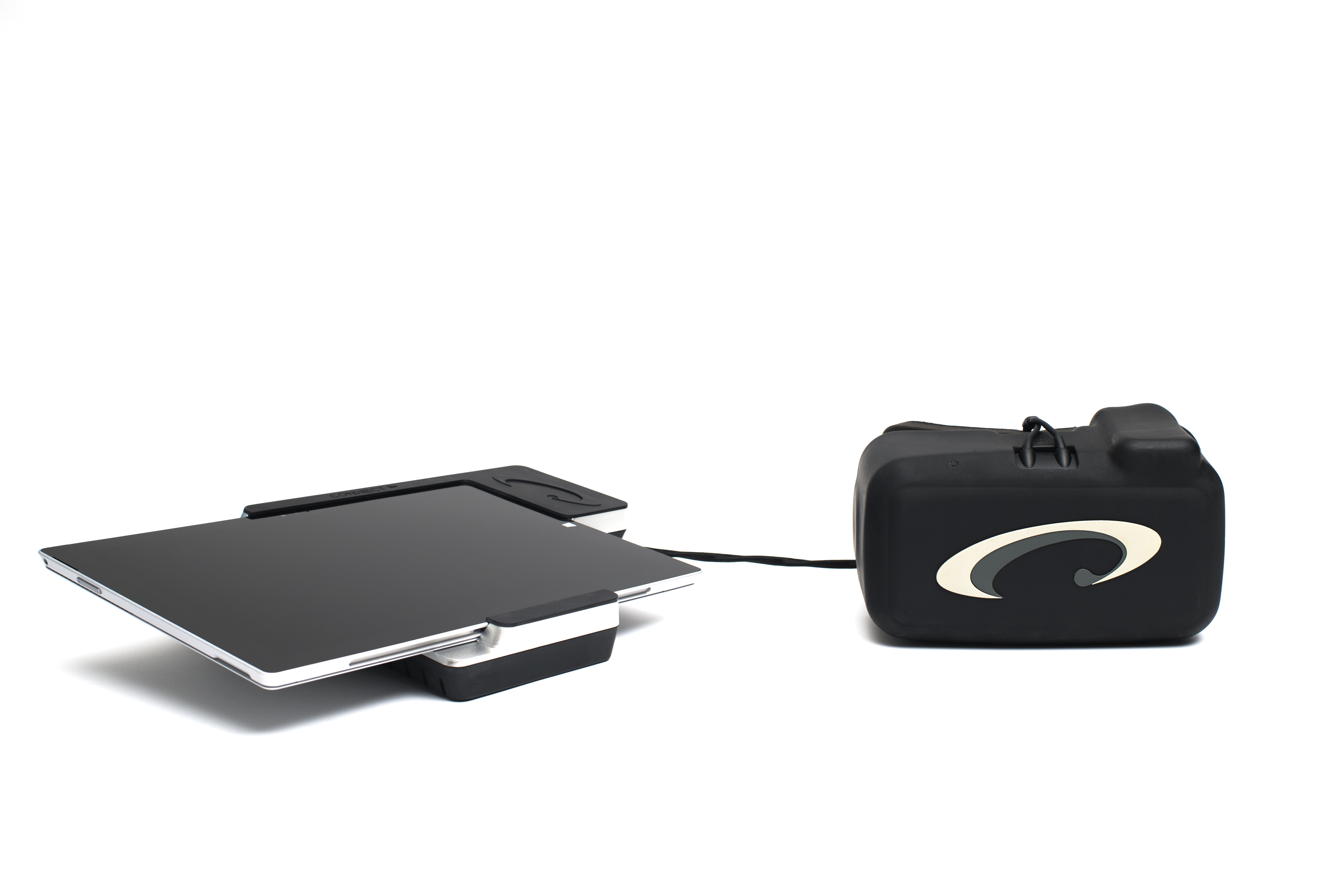 EYE-SYNC is a head-mounted eye tracking device that allows for rapid, reliable recording, viewing and analyzing of eye movement impairment through the use of virtual reality. In just 60 seconds, the device is able to determine common deficits after a concussion based on abnormal eye movements.
EYE-SYNC can be used in clinics or hospitals, on the sports field and even on the battlefield. In sports, EYE-SYNC can notify trainers if an athlete is suffering from a brain injury in less time than a medical timeout, while on the battlefield, commanders can better care for troops when head injuries are detected early, before they become life threatening.
The EYE-SYNC system includes the goggle piece and a tablet. The hand-held goggles are equipped with eye tracking technology. A dot moves in different directions on the goggle lens to determine if the eyes are moving simultaneously, looking in the same direction, and are able to follow movements. The attached tablet allows the assessor to see eye movement in real time and make decisions quickly based on the 60-second test.
The device was developed in collaboration with the Brain Trauma Foundation. Its clients, who have tested EYE-SYNC first hand, include Stanford Sports Medicine and the U.S. Army.
“In my opinion, the EYE-SYNC device has significant implications for sideline evaluation, and I can see in the future how this can be the diagnostic gold standard for sports related concussion with every pro, college, and high school team having one on the field,” said Scott Anderson, MA, ATC, Director of athletic training for Stanford University Sports Medicine. Anderson continued, “Stanford Sports Medicine currently uses EYE-SYNC technology as an investigational device to screen athletes for concussion and make decisions on return to play.”
 SyncThink currently has 10 granted patents and a normative database that includes more than 10,000 individuals, as well as more than 40 peer-reviewed research articles characterizing the impact of concussion on visual attention.
EYE-SYNC is now available for purchase via the SyncThink website and includes a custom briefcase, tablet, EYE-SYNC device, and user manual.
… We’d like to tell you about our mission and how you can help us fulfill it. SiliconANGLE Media Inc.’s business model is based on the intrinsic value of the content, not advertising. Unlike many online publications, we don’t have a paywall or run banner advertising, because we want to keep our journalism open, without influence or the need to chase traffic.The journalism, reporting and commentary on SiliconANGLE — along with live, unscripted video from our Silicon Valley studio and globe-trotting video teams at theCUBE — take a lot of hard work, time and money. Keeping the quality high requires the support of sponsors who are aligned with our vision of ad-free journalism content.
If you like the reporting, video interviews and other ad-free content here, please take a moment to check out a sample of the video content supported by our sponsors, tweet your support, and keep coming back to SiliconANGLE.






