 WIKIBON
WIKIBON
WIKIBON






WIKIBON

Public cloud, with its unlimited resources, high flexibility, and OpEx pricing model, is attractive to enterprises. But so far a variety of issues, including low latency requirements that cannot tolerate public Internet speed variations, geographic compliance issues and the cost of migration and retraining IT techs have stymied adoption.
In theory, the solution to these stumbling blocks is hybrid cloud. But, writes Wikibon Analyst Brian Gracely, so far hybrid cloud technologies have suffered from a lack of needed tools and have failed to deliver the advantages of public cloud platforms. Basically, the technology has been too immature to support the true integration that would allow the public and private parts of the hybrid cloud to operate as the single entity.
Now a fourth generation of hybrid cloud is emerging that promises to solve those problems, bringing many of the benefits of public cloud into the data center while providing close integration with public cloud. One of the first of this new generation to emerge is the just-announced Oracle Cloud Machine, Gracely writes. If it delivers on promises it will fulfill much of that hybrid cloud vision.
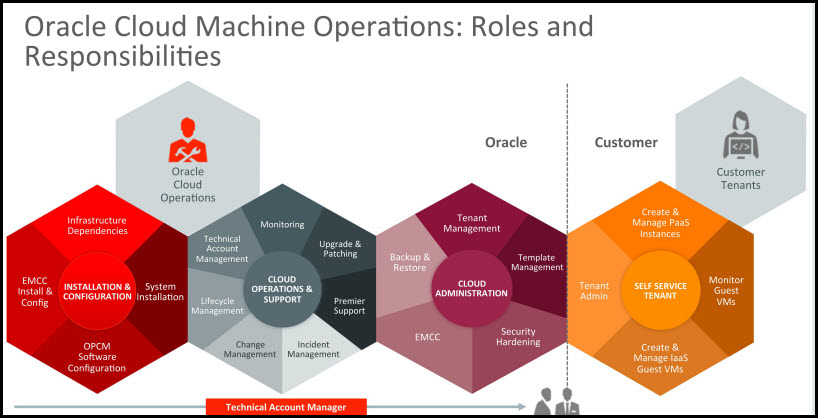
The Oracle Cloud Machine is a preloaded full cloud system out of the box. Oracle charges a monthly fee, a la public cloud, but runs the machine on the customer’s premise. Oracle refers to its vision as “same:same” between on-premise and public cloud.
The machine comes with the cloud management software, common operational model and operational consistency with the Oracle public cloud and a duplicate infrastructure from server to application with Oracle cloud.
Oracle is promising upgrades every three to six months, and will install them for the customer. It also promises to work closely with customers on scheduling these updates to minimize disruption. Finally, Oracle promises transparent two-way migration between the public and private clouds so that users will not know or care where their services reside.
Gracely warns that the public and private parts of this or any hybrid cloud will never be completely the same. For instance, public cloud platforms have effectively unlimited resources. In contrast, the Oracle Cloud Machine comes in three configurations, but IT on-premise resources are limited. The machine will also have many – but not all – of the features of the Oracle Public Cloud at launch. More will be added later. And while Oracle will work closely with customers, on-premise update schedules may not always parallel the public cloud, so that the two sides may be out of sync from time to time.
Gracely also cautions that because the machine is new, Wikibon has not yet had the opportunity to talk with users. However, presuming that Oracle delivers on its promises, he says this will be a major step forward both for Oracle and for its customers.
The full Professional Alert, “Oracle takes the Next Step with Oracle Cloud Machine,” discusses the challenges of hybrid cloud in general and the features, and limitations of the Oracle Cloud Machine specifically, in detail.
Support our mission to keep content open and free by engaging with theCUBE community. Join theCUBE’s Alumni Trust Network, where technology leaders connect, share intelligence and create opportunities.
Founded by tech visionaries John Furrier and Dave Vellante, SiliconANGLE Media has built a dynamic ecosystem of industry-leading digital media brands that reach 15+ million elite tech professionals. Our new proprietary theCUBE AI Video Cloud is breaking ground in audience interaction, leveraging theCUBEai.com neural network to help technology companies make data-driven decisions and stay at the forefront of industry conversations.





