



 NEWS
NEWS
NEWS
NEWS
NEWS

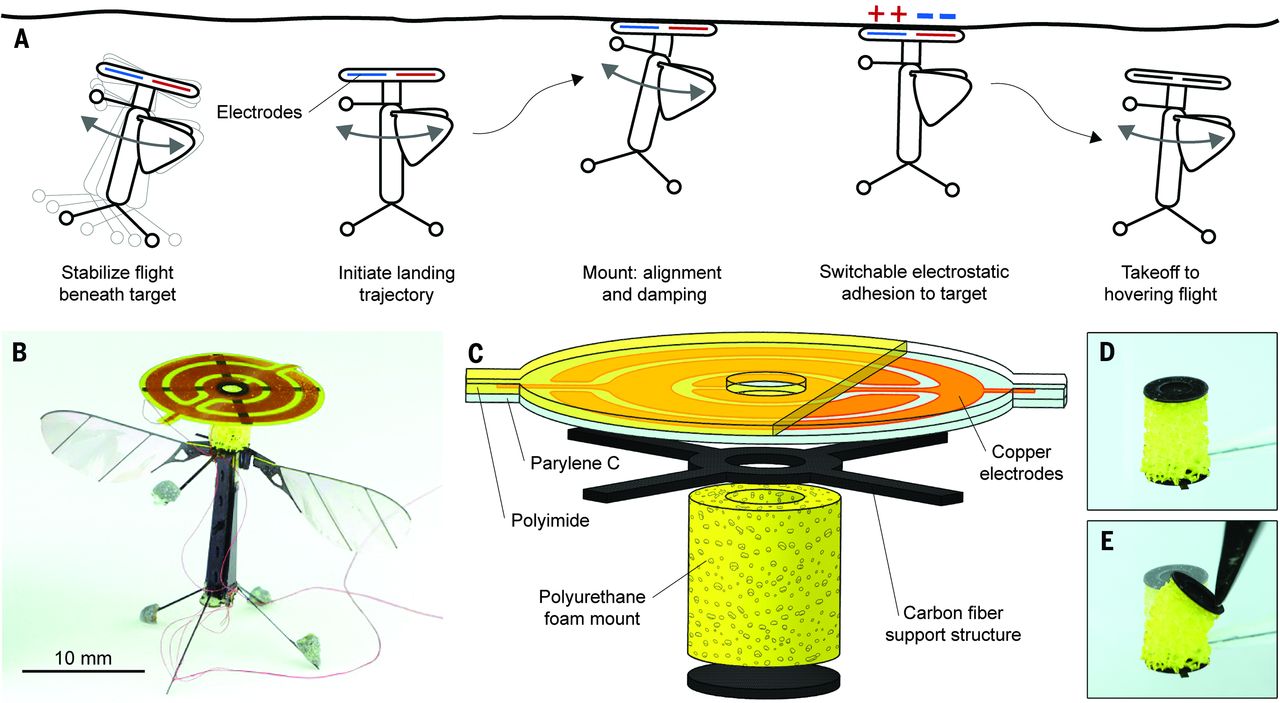
Researchers from the Massachusetts Institute of Technology (MIT) and Harvard University have developed a tiny drone called “RoboBee,” which they say is capable of landing on nearly any surface, much like an actual bee.
In a research paper published in the journal Science, the team behind RoboBee said that one of the biggest challenges facing drones is the fact that their flight time is limited by their power consumption, and this is especially true of smaller drones, which have smaller power sources. To overcome this challenge, the researchers looked to nature for inspiration, specifically the way in which flying insects perch on elevated surfaces, allowing them to consume less energy while still being able to observe their surroundings.
This concept has already been attempted with other drones, but the researchers explained that existing solutions limit the drones to landing on rough or magnetic surfaces. Meanwhile, RoboBee is capable of landing on a far greater variety of surfaces thanks to its use of static electricity, much in the same way that your socks are always getting stuck to your sweaters when they come out of the dryer.
RoboBee utilizes “a switchable electroadhesive” that allows it to cling to almost any surface. While the drone is perched, it consumes three orders of magnitude less power than when it is in flight, greatly increasing the length of time it can remain in a given area.
In an interview with Mashable, researcher Robert Wood noted that RoboBee’s capabilities could be extremely useful in “basically any situation where you want to have low cost and distributed sensing [that] would be too difficult or too dangerous for a human.”
Of course, this technology could also be incredibly useful in the world of surveillance, as a small microphone or camera could be deployed pretty much anywhere with an open window.
Wood noted that RoboBee’s static cling technology is still in its early stages, and it could be another 5 to 10 years before similar drones are ready for mass production.
… We’d like to tell you about our mission and how you can help us fulfill it. SiliconANGLE Media Inc.’s business model is based on the intrinsic value of the content, not advertising. Unlike many online publications, we don’t have a paywall or run banner advertising, because we want to keep our journalism open, without influence or the need to chase traffic.The journalism, reporting and commentary on SiliconANGLE — along with live, unscripted video from our Silicon Valley studio and globe-trotting video teams at theCUBE — take a lot of hard work, time and money. Keeping the quality high requires the support of sponsors who are aligned with our vision of ad-free journalism content.
If you like the reporting, video interviews and other ad-free content here, please take a moment to check out a sample of the video content supported by our sponsors, tweet your support, and keep coming back to SiliconANGLE.






