



 NEWS
NEWS
NEWS
NEWS
NEWS

CloudBolt Software Inc. has added cloud bursting support to its virtual machine self-provisioning software, enabling customers to specify CPU thresholds at which workloads can automatically expand into public infrastructure-as-a-service without user intervention.
Cloud bursting is simple in concept but difficult in execution. The idea is to relieve temporary spikes in demand that can bog down server performance by automatically reallocating resources to public or private clouds. For example, a retailer may cloud burst its e-commerce traffic during the holiday season but confine it to local servers at other times of the year.
In reality, setting up a cloud bursting environment requires a lot of configuration and compatibility testing to ensure that the public cloud and on-premise platforms are fully compatible.
CloudBolt says it’s automated the transitioning process. “We’ve had auto-scaling for some time. Now we’ve got the ability to say that when you reach maximum number of servers you can cross over into a different environment,” said Chief Technology Officer Bernard Sanders. CloudBolt’s core products enable self-provision of virtual machines with IT control.
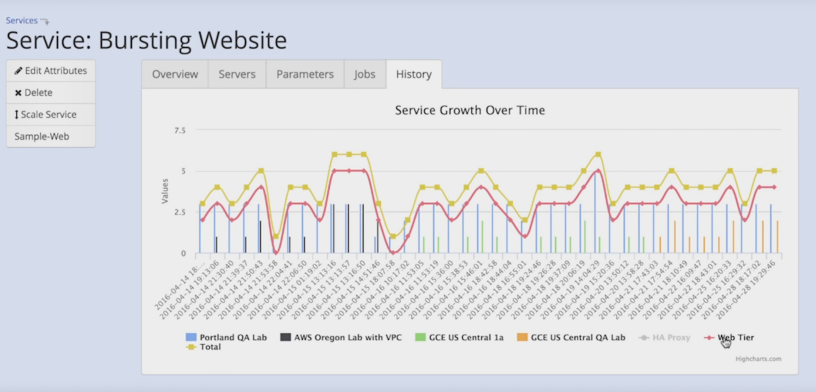
Customers create blueprints in CloudBolt that describe the application and the threshold for bursting. The current release supports only CPU load thresholds. Future releases will allow bursting based upon parameters like memory, storage and network utilization, Sanders said. Detailed records of cloud bursting events are kept for IT analysis (see image above). CloudBolt supports 14 resource handler technologies, including seven public clouds, six private virtualization technologies and physical server provisioning. The service also integrates with several popular load balancers.
Customers can choose to extend the basic bursting functionality by updating a JavaScript Object Notation (JSON) document and modifying some Python code. For example, a statement like “Application maximum response time=100ms” could be added in this manner, Sanders said. Customers are still responsible for validating compatibility between platforms.
The cloud bursting capability includes the following features:
The cloud bursting feature is a no-charge upgrade to CloudBolt’s existing software, which is sold on the basis of the number of virtual machines supported. For example, a 100-VM installation costs $12,500.
… We’d like to tell you about our mission and how you can help us fulfill it. SiliconANGLE Media Inc.’s business model is based on the intrinsic value of the content, not advertising. Unlike many online publications, we don’t have a paywall or run banner advertising, because we want to keep our journalism open, without influence or the need to chase traffic.The journalism, reporting and commentary on SiliconANGLE — along with live, unscripted video from our Silicon Valley studio and globe-trotting video teams at theCUBE — take a lot of hard work, time and money. Keeping the quality high requires the support of sponsors who are aligned with our vision of ad-free journalism content.
If you like the reporting, video interviews and other ad-free content here, please take a moment to check out a sample of the video content supported by our sponsors, tweet your support, and keep coming back to SiliconANGLE.






