



 NEWS
NEWS
NEWS
NEWS
NEWS

The 3D printing movement has brought us all sorts of printable objects, from medical devices to guns, and now it seems that people are even starting to print entire buildings.
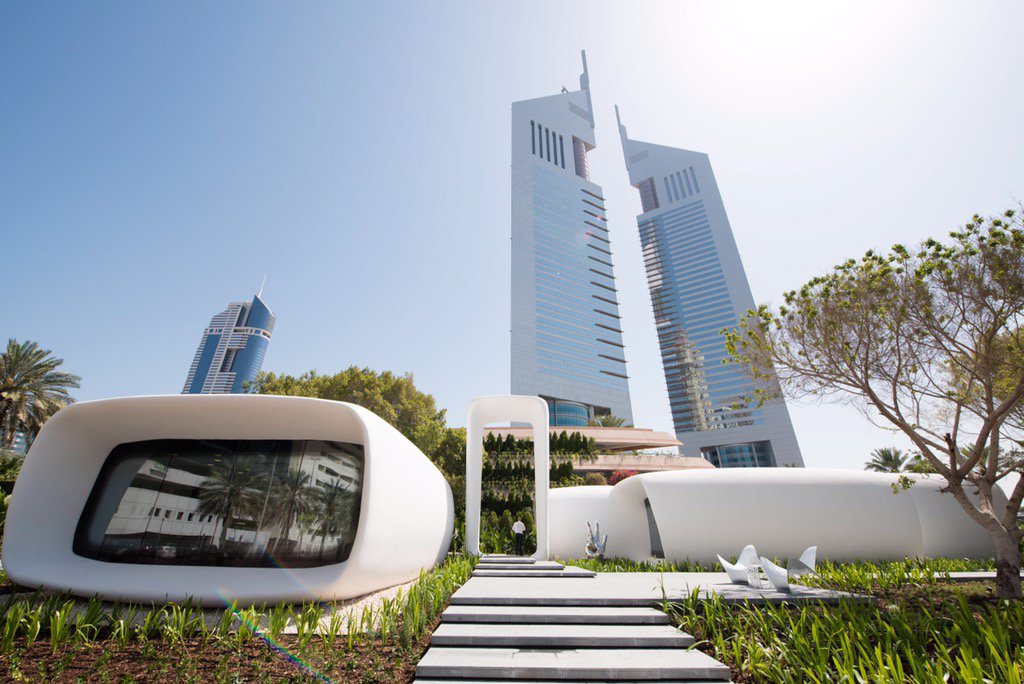
This week, the architectural wonderland that is the city of Dubai unveiled what it says is the first fully 3D printed office building, which located near the city’s Museum of the Future project. First announced nearly one year ago, the 3D printed office project will serve as a temporary headquarters for the staff of the Dubai Future Foundation.
“We announce today the opening of the first 3D-printed office in the world, after less than one month of launching Dubai 3D printing strategy which showcases a modern model of construction,” Sheikh Mohammed bin Rashid Al Maktoum, the Vice President and Prime Minister of the United Arab Emirates, said at the structure’s grand opening. “This is an experience we present to the world on utilizing future technology in people lives. It also represents a new milestone for the UAE as a global leader in strategic achievements”
He added, “We see this project as a case study that will benefit regulators as well as research and development centres at the regional and international levels on real application of 3D printing technology. We are documenting this experience and building on it to take advantage of the most important lessons, which will serve as reference points to take this technology to new levels.”
According to the Government of Dubai’s statement, the office was created using a special cement mixture that was printed layer by layer, taking a total of 17 days to be fully constructed. The specialized printer used to create the building measures 20 feet tall, 120 feet long, and 40 feet wide, making it one of the largest 3D printers in the world.
There are a number of benefits to using 3D printing technology in construction, not the least of which is the fact that the measurements and material composition of each completed structure is virtually identical. Another major benefit is the fact that the entire project required a staff of only one person to monitor the printing process itself, as well as an additional seven people to install the structure at the build site.
Even with another 10 specialists required to handle the mechanical and electrical engineering, Dubai notes in its statement that the labor costs were roughly 50 percent lower than those of a conventional building of a similar size.
… We’d like to tell you about our mission and how you can help us fulfill it. SiliconANGLE Media Inc.’s business model is based on the intrinsic value of the content, not advertising. Unlike many online publications, we don’t have a paywall or run banner advertising, because we want to keep our journalism open, without influence or the need to chase traffic.The journalism, reporting and commentary on SiliconANGLE — along with live, unscripted video from our Silicon Valley studio and globe-trotting video teams at theCUBE — take a lot of hard work, time and money. Keeping the quality high requires the support of sponsors who are aligned with our vision of ad-free journalism content.
If you like the reporting, video interviews and other ad-free content here, please take a moment to check out a sample of the video content supported by our sponsors, tweet your support, and keep coming back to SiliconANGLE.






