



 NEWS
NEWS
NEWS
NEWS
NEWS

Managing application projects is about to become much easier for GitLab Inc. users. The startup today introduced an issue tracking feature for its fast-growing code hosting platform that promises to help development teams organize the features, enhancements and other items on their to-do lists more effectively.
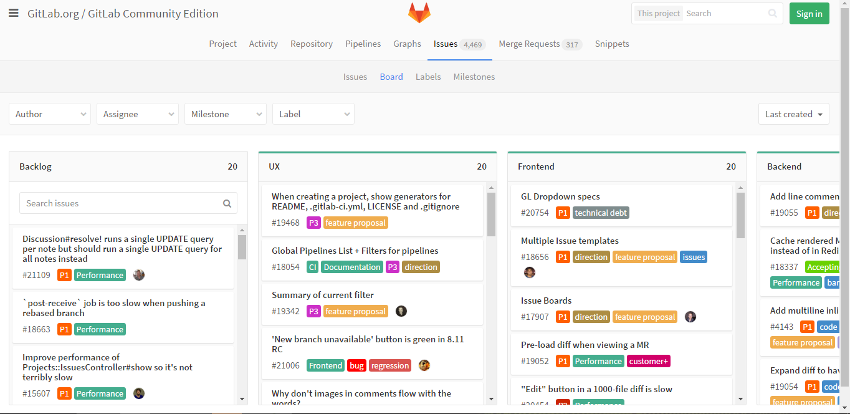
The GitLab Issue Board is a sleek graphical panel that provides the ability to display tasks as digital note cards and sort them into neat columns each representing a different part of the application lifecycle. By default, new panels start only with a “Backlog” section for items still in the queue and a “Done” list that shows completed tasks, but users are able to easily add more tabs if necessary. GitLab says that a view can be broken up into as many lists as a project requires.
An enterprise development team working on an internal client-server service, for instance, could create separate sections to hold backend tasks, issues related to the workload’s desktop client and user experience bugs. Users with such crowded boards can also take advantage of GitLab’s built in tagging mechanism to label each item with color-coded tags denoting its purpose. The feature not only helps quickly make sense of the cards on a given board but also makes it easier to find specific items in the process. When an engineer wants to check if there are new bug fix requests concerning their part of a project, they can simply filter the board view based on the appropriate tags.
And to make the process even smoother, GitLab has set the tagging mechanism to automatically refresh labels when an entry is moved between columns. This means that a note card tagged with the word “Backlog” will be modified if it’s moved the “Done” section of a board. The startup hopes that the functionality will make users of its code hosting platform less likely to employ third party issue trackers like rival Atlassian Inc.’s JIRA.
Moreover, GitLab Issue Board should also put it in a better position to compete with arch-nemesis GitHub Inc., which has been offering a native issue tracker of its own for quite some time now. The companies can be expected to adding more and more value-added features to their respective platforms as the code management market continues to heat up.
… We’d like to tell you about our mission and how you can help us fulfill it. SiliconANGLE Media Inc.’s business model is based on the intrinsic value of the content, not advertising. Unlike many online publications, we don’t have a paywall or run banner advertising, because we want to keep our journalism open, without influence or the need to chase traffic.The journalism, reporting and commentary on SiliconANGLE — along with live, unscripted video from our Silicon Valley studio and globe-trotting video teams at theCUBE — take a lot of hard work, time and money. Keeping the quality high requires the support of sponsors who are aligned with our vision of ad-free journalism content.
If you like the reporting, video interviews and other ad-free content here, please take a moment to check out a sample of the video content supported by our sponsors, tweet your support, and keep coming back to SiliconANGLE.






