



 NEWS
NEWS
NEWS
NEWS
NEWS

Salesforce.com outpaced earnings expectations once again today, but it wasn’t enough to make investors happy.
The company’s shares were falling more than 8 percent in after-hours trading following a day when shares were down about a half percentage point, to $79.42 a share. The reason: Its third-quarter revenue guidance of $2.11 billion to $2.12 billion came in slightly shy of the $2.13 billion analysts on average were expecting.
The company always faces a high bar on results, since it has met or beaten Wall Street estimates for revenues and profits every quarter for the past seven years. Its shares are up 14 percent over the past year.
“Investors were undoubtedly disappointed by the modest expectations for deferred revenue growth during the third quarter, projected to rise by 20% year-over-year vs. rates of growth more typically in the high 20s or low 30s,” Pivotal Research Group analyst Brian Wieser said in a note to clients. Company executives in the earnings conference call indicated that trend was not new and said they weren’t concerned. “Overall, we think these results represented a continuation of recent trends, without a major negative or positive read-through vs. prior expectations,” Wieser added.
The provider of cloud-based sales and marketing management services, known as customer relationship management (CRM), earned a second-quarter profit before certain costs such as stock compensation and acquisition-related expenses of 24 cents a share, up from 19 cents a share last year. Sales rose 25 percent from a year ago, to $2.04 billion. Executives noted some “softness” in the U.S., though they said they didn’t believe it was any indication of issues in the broader economy.
Analysts polled by FactSet had forecast a profit before certain costs of 22 cents a share, at the high end of Salesforce’s guidance of 21 cents to 22 cents a share, on revenues of $2.02 billion, up from $1.63 billion a year ago. Net income hit $229.6 million, reversing a loss a year ago.
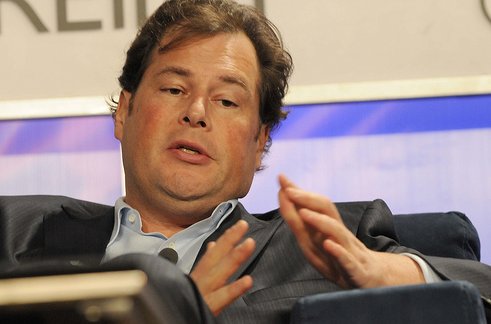
“No other enterprise software company of our size is growing at this pace,” Marc Benioff (pictured above), Salesforce’s chairman and chief executive officer, said in a statement that echoed a common theme of his.
He also noted that the company now has three billion-dollar annual revenue businesses and is about to add another with its Marketing Cloud services. The company’s Sales Cloud revenues rose 13 percent, to $754.9 million, though as the original offering, its sales increase was the slowest of four groups. Service Cloud revenues were up 29 percent, to $575.4 million; App Cloud and other services revenues jumped 43 percent to $353.4 million; and Marketing Cloud revenues rose 28 percent, to $202.4 million.
For its fiscal 2017, the company, one of the pioneers in cloud computing, provided guidance of 93 to 95 cents a share in profit and $8.275 billion to $8.325 billion in revenues. Analysts had forecast 95 cents and $8.31 billion.
Investors remain concerned about Benioff’s stepped-up acquisition spree. So far this year, Salesforce has already acquired more companies than in all of last year, including its largest acquisition yet: the $2.8 billion deal announced June 1 for e-commerce services provider DemandWare. The company also made a bid to buy LinkedIn Corp., which Microsoft Corp. ended up buying for $26 billion in June.
Trip Chowdhry, an analyst with Global Equities Research, said in a note to clients that Salesforce’s underlying technology “stack,” based on hardware and software from some traditional vendors such as Oracle Corp., Hewlett-Packard Enterprise Co. and Cisco Systems Inc., is more expensive relative to cloud computing providers such as Amazon Web Services. That presents a long-term challenge, he said.
Benioff chose to look ahead in comments during the earnings call. At Dreamforce, its user conference to be held in early October in San Francisco, the company will unveil Salesforce Einstein, which Benioff called “the world’s first comprehensive artificial intelligence platform for CRM.”
The platform is built on a series of acquisitions of AI companies in recent years. “We’ve been able to stitch these into an amazing AI platform,” Benioff said. “We’ve never been better positioned for the future.”
Chowdhry said Salesforce’s AI acquisitions are a promising bright spot for the company.
… We’d like to tell you about our mission and how you can help us fulfill it. SiliconANGLE Media Inc.’s business model is based on the intrinsic value of the content, not advertising. Unlike many online publications, we don’t have a paywall or run banner advertising, because we want to keep our journalism open, without influence or the need to chase traffic.The journalism, reporting and commentary on SiliconANGLE — along with live, unscripted video from our Silicon Valley studio and globe-trotting video teams at theCUBE — take a lot of hard work, time and money. Keeping the quality high requires the support of sponsors who are aligned with our vision of ad-free journalism content.
If you like the reporting, video interviews and other ad-free content here, please take a moment to check out a sample of the video content supported by our sponsors, tweet your support, and keep coming back to SiliconANGLE.






