



 INFRA
INFRA
INFRA
INFRA
INFRA

With the acquisition of machine vision processor chip maker Movidius Ltd. today, Intel Corp. aims to boost its efforts to help all manner of devices from drones to virtual reality headsets see better.
The deal, whose value Intel didn’t reveal but one report estimated at $400 million, marks another big step for the giant chipmaker into deep learning neural networks. That’s the branch of machine learning that roughly emulates some of the activity of neurons in the brain to enable computers to learn to recognize patterns in masses of data representing images, speech and text.
At its developer forum a few weeks ago, Intel announced a broader foray into the Internet of Things, which requires both better artificial intelligence and low-power devices that can handle the processing needs of all the data needed for deep learning. Intel Chief Executive Brian Krzanich, whose company is under pressure to find new growth beyond the slowing personal computer market, unveiled Joule, a high-end computing platform on a small circuit board that Intel says will deliver “human-like senses” to any number of smart devices.
And about a month ago, Intel also announced the $400 million acquisition of Nervana Systems, which operates a cloud platform for deep learning and also was working on a chip optimized for deep learning.
Movidius may help Intel move more quickly into producing chips that can work using very low power, enabling more capable drones, robots, VR headsets and other devices. In January, Movidius announced a deal with Google Inc. to supply a chip that will be used in a future mobile device. And in April, it unveiled what it calls the first deep learning module on a USB stick, using only 1 watt of power.

Intel’s plans for computer vision technologies.
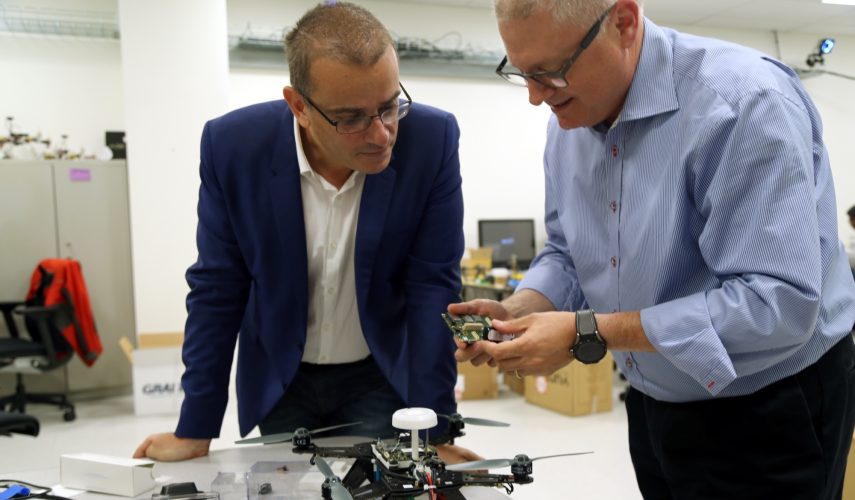
Movidius can accelerate Intel’s own longstanding depth-sensing camera technology, called RealSense, the company said. “Movidius’ technology optimizes, enhances and brings RealSense capabilities to fruition,” Josh Walden (above, right), senior vice president and general manager of Intel’s New Technology Group, said in a blog post.
Movidius Chief Executive Remi El-Ouazzane (above, left) said in an interview that while his company will keep its branding as part of Intel’s New Technology Group, joining with Intel provides a scale it couldn’t achieve on its own.
“It is one thing to create a new technology and start a market, but it’s another thing to ship it at scale,” he said. “Intel gives us that platform.”
The deal is yet another sign that traditional processor architectures such as Intel’s central processing units and graphics processing units made by the likes of Nvidia Corp. may not be ideal for emerging artificial intelligence tasks such as deep learning, especially for low-power mobile and Internet of Things devices.
“This kind of perceptual intelligence is becoming essential,” said Jeff Bier, founder and president of the embedded-chip consultant Berkeley Design Technology Inc. and founder of the industry group Embedded Vision Alliance. “Intel is opening up to alternative processor architectures — and they have to.”
Intel isn’t alone, Bier noted. ARM Holdings in May acquired embedded-vision Apical Ltd. for $350 million. Last September, Freescale Semiconductor Ltd. bought image cognition firm CogniVue Corp., whose chip cores are used in automobile safety applications.
Even though deep learning and other AI technologies are increasingly being offered as cloud services by the likes of Google, IBM Corp. and Microsoft Corp., the increasing requirements of mobile devices are pushing AI down to the chip. As deep learning becomes more widespread, it could enable many more companies to develop new applications, allowing computers to act a little more human.
Ten-year-old Movidius, based in San Mateo, California, with a large design center in Dublin, Ireland, employs about 180 people.
… We’d like to tell you about our mission and how you can help us fulfill it. SiliconANGLE Media Inc.’s business model is based on the intrinsic value of the content, not advertising. Unlike many online publications, we don’t have a paywall or run banner advertising, because we want to keep our journalism open, without influence or the need to chase traffic.The journalism, reporting and commentary on SiliconANGLE — along with live, unscripted video from our Silicon Valley studio and globe-trotting video teams at theCUBE — take a lot of hard work, time and money. Keeping the quality high requires the support of sponsors who are aligned with our vision of ad-free journalism content.
If you like the reporting, video interviews and other ad-free content here, please take a moment to check out a sample of the video content supported by our sponsors, tweet your support, and keep coming back to SiliconANGLE.






